Cloud Architecture ·
By Eneias Brum
Cloud Risk Prioritization: What to Fix First and Why
How to turn security, cost, reliability, and ownership findings into a defensible action plan.
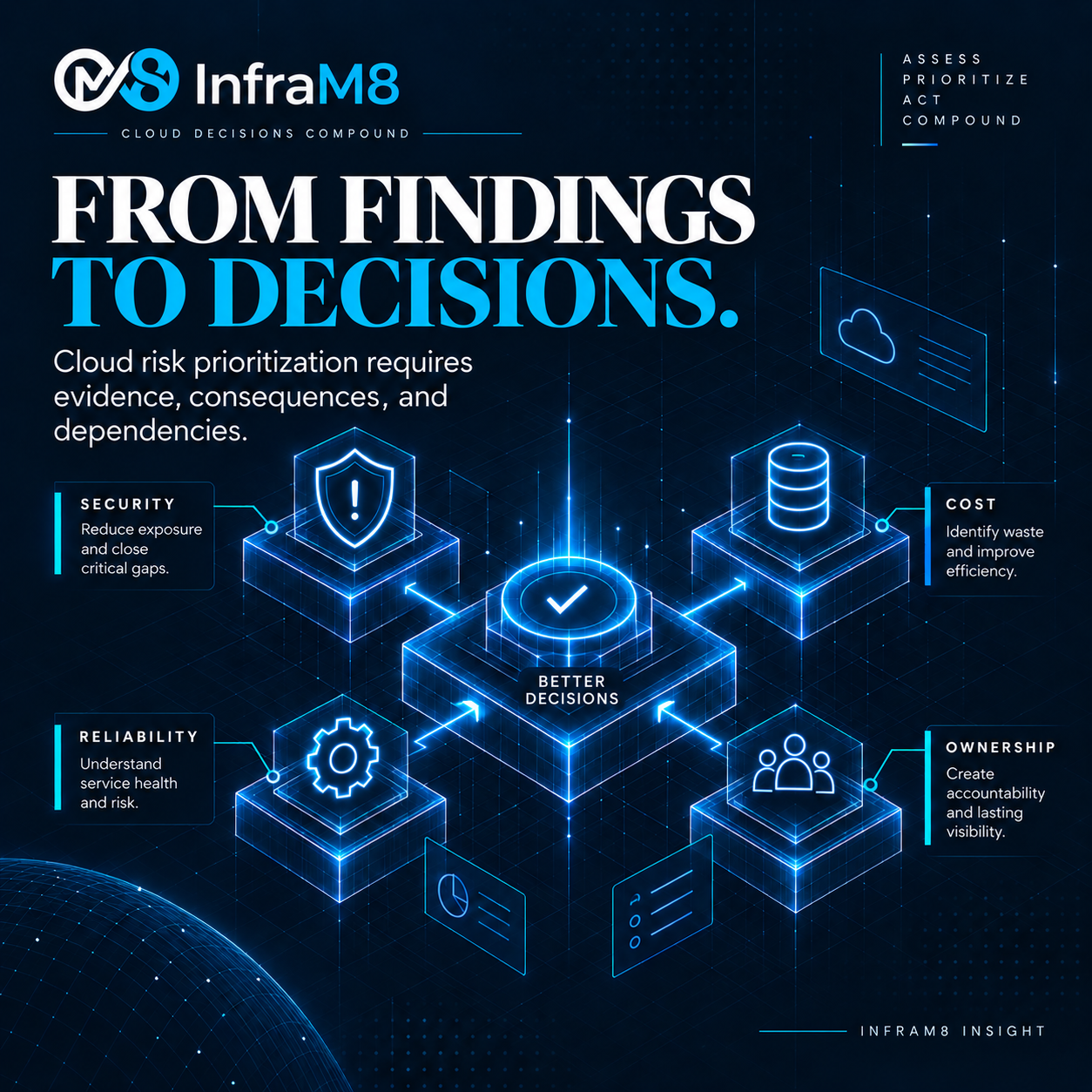
A list of findings is not an action plan.
Consider a hypothetical cloud review. An engineering team discovers an old administrative access grant, a database without recent recovery-test evidence, an unexplained cost increase, and a proposal to rebuild the platform.
The team cannot investigate and implement everything at once. Which action belongs first? Which needs more evidence? Which should not become a project yet?
AWS Well-Architected guidance recommends selecting improvements by their business impact and implementation effort, working on a manageable set, and tracking progress. That is a useful starting point. The harder work is explaining what the impact means in this environment. [1]
The purpose of prioritization is not merely to rank findings. It is to choose the next defensible action.
Methodological note: This article is a practitioner-oriented synthesis of primary guidance, not a research report. The scenario, three-question lens, response labels, decision record, and conceptual figures are Infram8 editorial constructions. They are not a client case, an empirically validated scoring model, or a method endorsed by the cited organizations. References support the specific principles attributed to them. The approach complements incident response and organization-specific risk management; it does not establish compliance or guarantee lower risk.
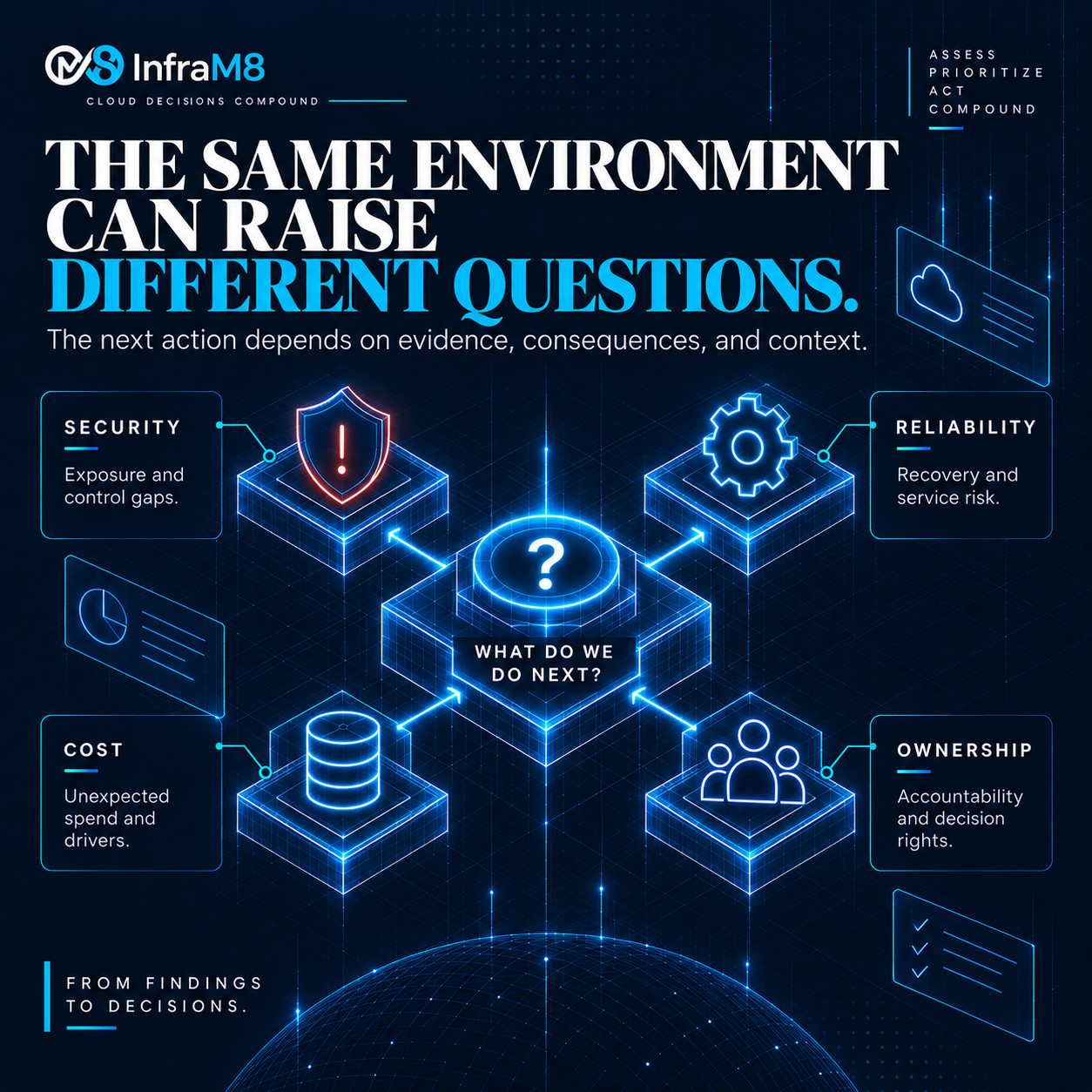
1. Separate the finding from the decision
For this discussion, use three working distinctions.
A finding records an observed condition: an access grant exists, spending changed, or a test record could not be located.
A risk assessment asks what could go wrong, under which conditions, with what plausible likelihood and consequence, considering existing controls and uncertainty. This framing draws on NIST risk-assessment concepts; it does not assign a probability to any finding in the example. [9]
A priority is a decision about action and timing under those conditions.
These distinctions are our organizing lens, not a new industry taxonomy. Their purpose is to avoid treating a missing document as a confirmed technical failure, or an unexplained cost increase as demonstrated waste.
NIST CSF 2.0 provides a related discipline for cybersecurity: compare current and desired outcomes, consider organizational objectives and requirements, and develop a prioritized action plan. The framework is designed to be adapted to context rather than applied as one universal sequence. [2]
Severity deserves the same care. FIRST describes CVSS as a way to communicate vulnerability severity. Threat and Environmental metrics can refine that assessment, while business factors such as monetary loss and the number of customers affected extend beyond its scope. [3]
A CVSS score is therefore an input to vulnerability prioritization, not a complete business decision. In this article, we do not repurpose it as a common score for backups, cloud spending, and ownership gaps. [3]
2. Ask what would change the decision
Before assigning an item to a sprint, make its assumptions explicit. We propose three questions.
What consequence are we trying to prevent? Identify the customer journey, data, or operation affected. Describe the relevant failure or misuse scenario, not just the component. Include deadlines or obligations that constrain the available choices.
What do we know, and what remains uncertain? Record the evidence, its date, coverage, and limitations. Separate a confirmed condition from an inference. Ask whether obtaining a specific missing fact would change the action, rather than investigating without a stopping rule.
What response is proportionate? Consider urgency, dependencies, implementation effort, and the risk introduced by the change itself. Ask whether a smaller, reversible intervention can address the immediate concern while the durable solution is prepared.
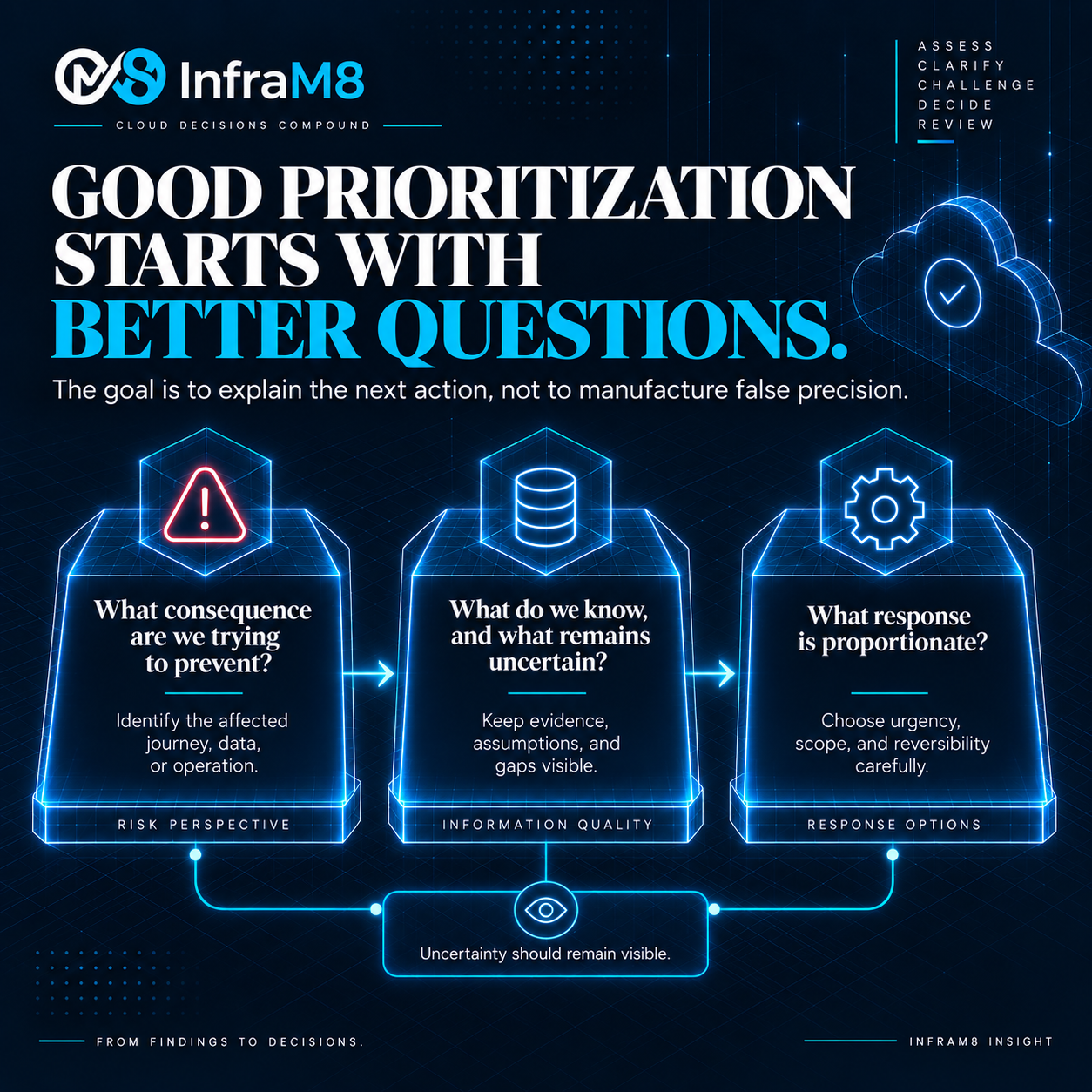
These questions are intended to produce an explanation, not a probability estimate. NIST SP 800-30 Rev. 1 recognizes qualitative, semi-quantitative, and quantitative approaches. It emphasizes clear definitions and the limits created by uncertainty or hidden subjective judgments. [9]
For this proposed workflow, retain the evidence and explain any scoring scale. Assigning numbers to qualitative labels does not, by itself, establish an empirically calibrated probability.
For this approach, uncertainty should remain visible. It is neither proof of failure nor permission to ignore a potentially serious consequence.
An uncertain finding can justify an urgent investigation without justifying a predetermined solution.
3. Apply the reasoning to one environment
Return to the hypothetical team. Its application relies on one production database, an external contractor has finished their assignment, and the team is preparing a database change. The evidence reviewed so far does not establish an active compromise. For this example, that is a limit of the available evidence, not a declaration that the environment is uncompromised.
The table below describes questions to resolve, not a universal ranking.
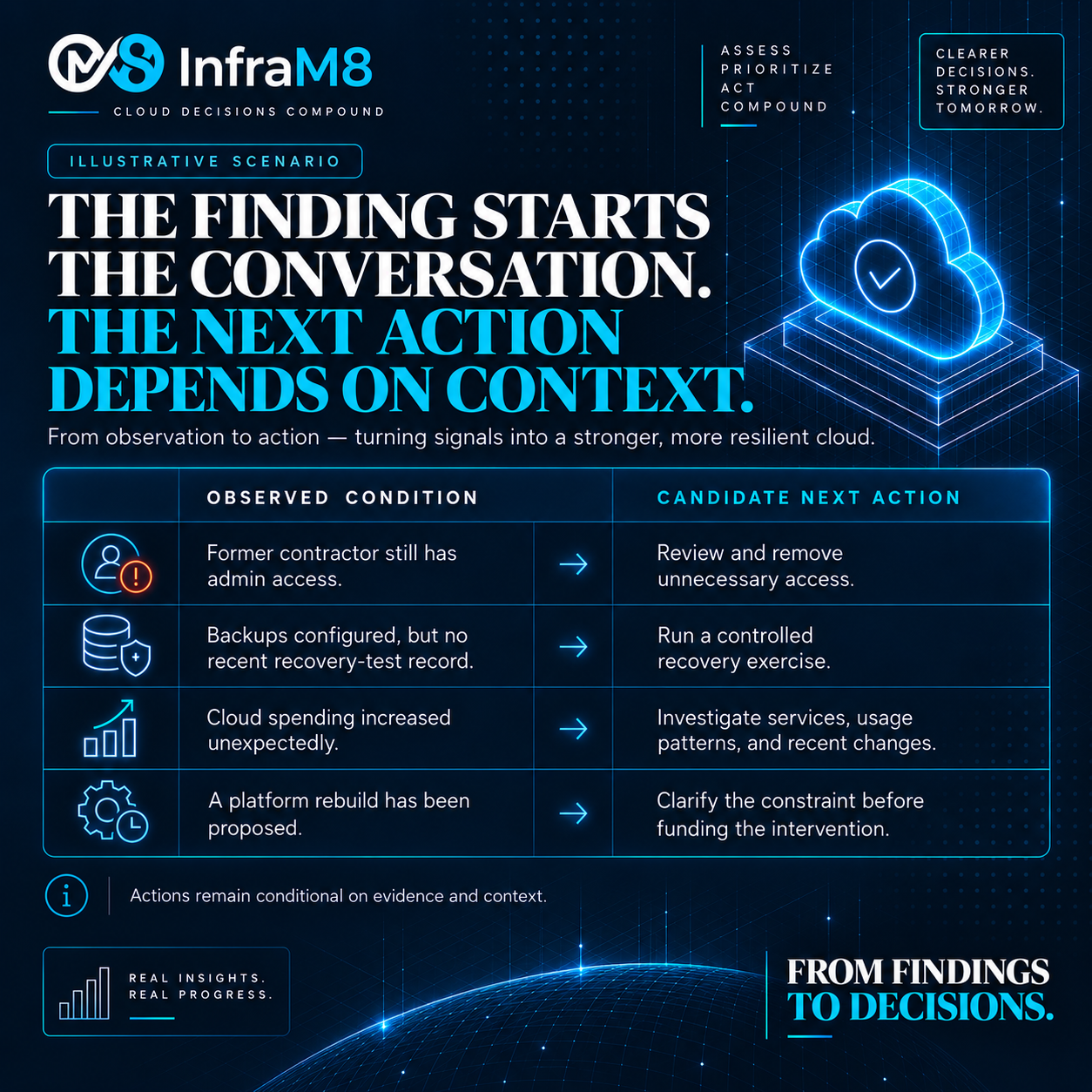
| Observed condition | Decision-changing evidence | Candidate next action |
|---|---|---|
| A former contractor still has an administrative access grant. | Whether access remains usable, any legitimate dependency, and evidence of suspicious activity. | Prompt access review and removal of access no longer required; escalate suspected compromise. |
| Backups are configured, but no recent recovery-test record is available. | Whether representative recovery meets agreed downtime and data-loss objectives. | A controlled recovery exercise before the planned database change. |
| Cloud spending increased unexpectedly. | The services, usage patterns, recent changes, and budget exposure involved. | A time-bounded investigation, followed by correction or a documented forecast adjustment. |
| A platform rebuild has been proposed. | The specific constraint it would remove and the alternatives available. | Defer implementation until the proposal has a supported problem statement. |
These are conditional proposals for this scenario. New evidence can change their urgency, scope, or sequence.
Access: reduce unnecessary access while preserving evidence
AWS recommends reviewing permissions as roles change and removing unnecessary access to reduce the potential impact of unauthorized credential use. [4]
In our example, suppose the owner confirms that the contractor's access is still usable and no longer required. Promptly removing that access is justified without waiting for proof of misuse. Reviewing available activity records is a separate task.
If credible evidence indicates credential compromise or active malicious activity, use the organization's incident-response and escalation procedures rather than ordinary backlog planning. In its Security Incident Response service guidance, AWS describes containment as limiting further harm while preserving evidence and considering the impact of isolation or access changes. [5]
For this example, removing the grant addresses the unnecessary-access finding. It is not the acceptance criterion for an entire incident: verify the effect of the action, review related access and activity as appropriate, and retain relevant evidence. [5]
Recovery: verify capability before choosing a replacement
AWS recommends testing recovery against recovery time and recovery point objectives, while checking that restored data is intact and usable. These address the required recovery time and the acceptable recovery point, including potential data loss. Backup configuration alone does not demonstrate those outcomes. [6]
For this team, we propose an authorized exercise in a separate, controlled environment, with representative data and application checks. Protect any restored sensitive data and avoid exposing it publicly. Agree the objectives first if they are missing.
Use the outcome to distinguish missing evidence from inadequate capability before choosing replacement tooling.
Cost: explain the increase before reducing capacity
The FinOps Foundation treats anomaly management as investigation and resolution of unexpected spending. A valid resolution can involve changing the environment, adjusting expectations, or documenting why an alert occurred. [7]
For the scenario, compare spending with workload demand, affected services, and recent deployments. Increased demand and an accidental resource change imply different responses.
Set an investigation deadline and an escalation threshold for projected budget impact. Investigation must not become indefinite tolerance of uncontrolled spending.
The decision is not automatically “spend less.” It is to explain the change and choose an appropriate response.
Rebuilding: establish the constraint before funding the intervention
For the hypothetical rebuild, require a concrete problem: unacceptable recovery, a demonstrated capacity limit, or a deployment constraint that smaller changes cannot adequately address.
For reliability work, Google's SRE guidance uses service level objectives to connect engineering priorities with expected user benefit. It does not treat all reliability investments as equally valuable. [8]
In this scenario, we would defer the rebuild until its expected benefit can be compared with narrower alternatives. Deferring the project is not accepting every current weakness. It leaves room to address the access and recovery issues independently.
4. Sequence actions, not entire categories
Suppose the investigation confirms unused contractor access, leaves recovery capability unverified, attributes most of the cost increase to expected demand, and finds no demonstrated need for rebuilding.
A defensible plan for these assumptions would remove the access, complete the controlled recovery exercise, document the cost explanation and remaining questions, and withhold approval for the rebuild.
The order is not “security always first, cost always later.” Evidence of uncontrolled spending or an ongoing availability incident would change the plan.
Nor must every task be serial. Independent owners can investigate cost and prepare a recovery exercise in parallel. A database change, however, may depend on understanding the recovery path.
Our proposed decision labels are contain, investigate, remediate, and defer with review conditions. They describe available responses, not permanent classifications or mandatory stages. One issue may need containment and investigation in parallel, followed by remediation. Another may need only a bounded investigation or a documented decision to defer.
Not every case requires all four responses, and their visual order is not an execution order. When an incident-response plan applies, these editorial labels do not replace its procedures.
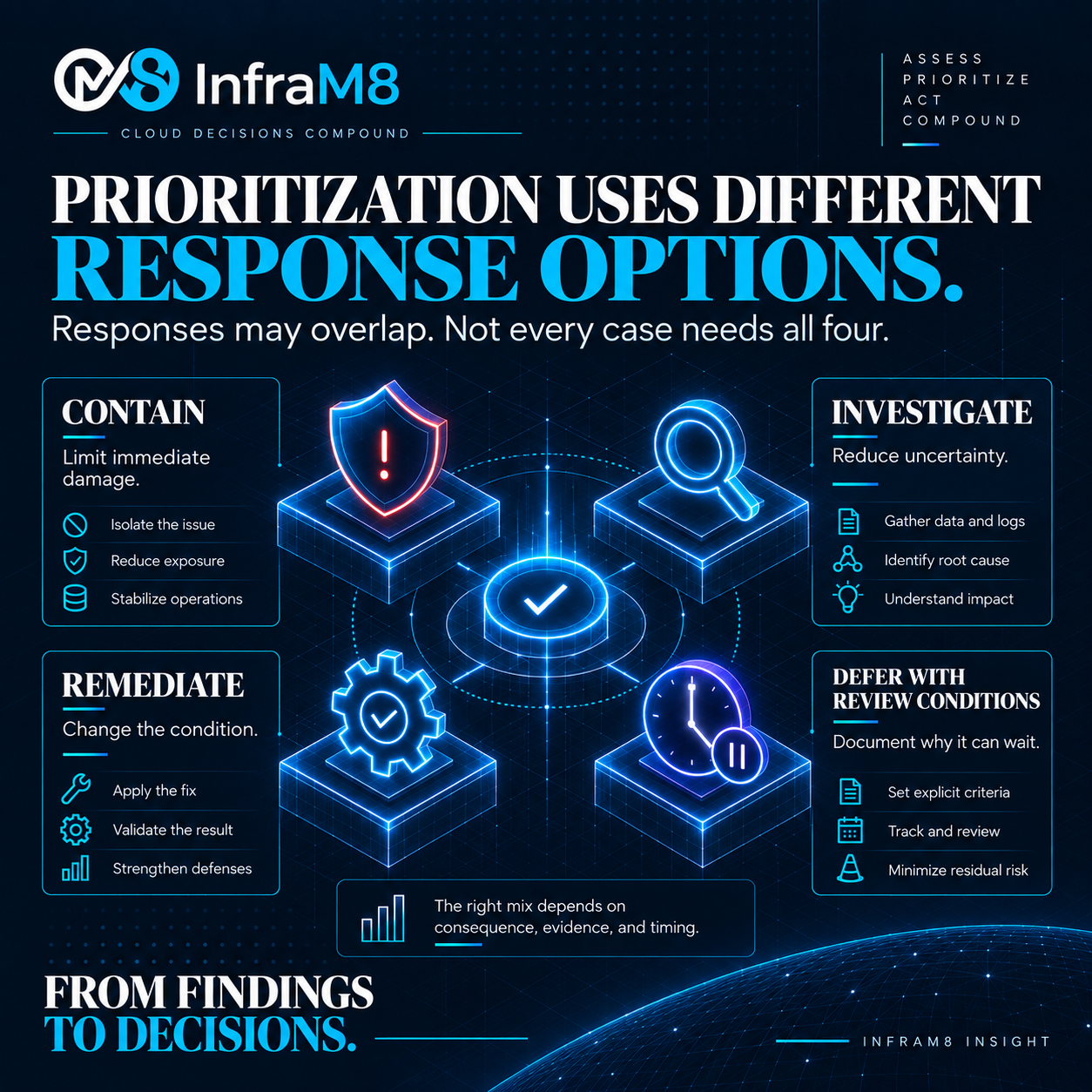
Effort influences how to execute the response. It should not make a consequential but difficult issue disappear from the plan merely because easier tickets exist.
5. Write down why the decision is defensible
We propose a compact decision record for each material item. Here is a filled example for the recovery question. The named roles and five-business-day deadline are illustrative assumptions, not a service commitment or a deadline prescribed by the sources. A real team must set timing from its exposure, change schedule, and available resources.
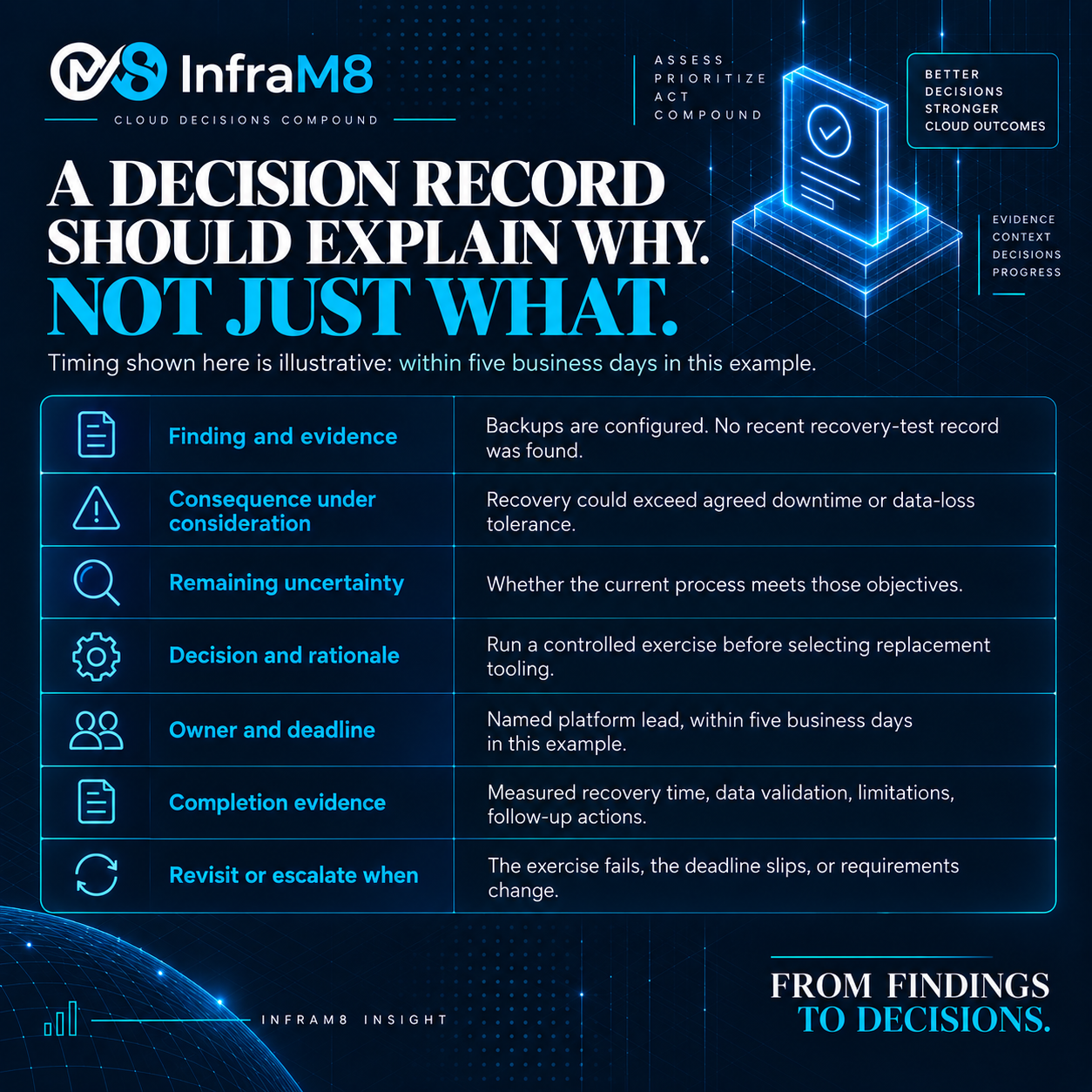
| Field | Example entry |
|---|---|
| Finding and evidence | Backups are configured. No recent recovery-test record was located in the reviewed material. |
| Consequence under consideration | A recovery could exceed the application's agreed downtime or data-loss tolerance. |
| Remaining uncertainty | Whether the current recovery process and application checks meet those objectives. |
| Decision and rationale | Run a controlled exercise before selecting replacement tooling or approving the planned database change. |
| Owner and deadline | The named platform lead, within five business days in this example. The CTO reviews any proposed delay. |
| Completion evidence | A test report documenting measured recovery time, the recovered data point and any observed loss against the objective, data and application checks, test scope, limitations, and follow-up actions. |
| Revisit or escalate when | The exercise fails, the deadline slips, or workload requirements or the recovery design change. |
Completing an investigation is not the same as resolving the underlying risk. A failed exercise can close the testing task while opening corrective actions. A successful exercise provides evidence within its tested scope, not a guarantee for every future failure.
For temporary risk acceptance, our proposed record includes the authorized decision maker, the rationale, and review or expiry conditions. This is an implementation choice, not a claim that CSF mandates this exact template. NIST CSF 2.0 addresses risk-management roles and authorities in GV.RR-02 and the planning, tracking, and communication of risk responses in ID.RA-06. [2]
This record is not intended to replace an existing risk register. Use it within the team's current process instead of creating a competing system.
6. Measure the outcome, not just the number of closed findings
For this scenario, review whether unnecessary access is actually removed, whether recovery has been demonstrated within the agreed scope, whether the spending increase is explained, and whether the rebuild decision has a clear basis.
Those questions test the outcome of the selected actions. Counting closed tickets alone would not answer them.
AWS Well-Architected guidance recommends owners, specific goals, and solutions that favor simplicity where additional complexity is not required. [1]
Our corresponding operating rule is straightforward: every material recommendation should state its reason, owner, next evidence, and review condition.
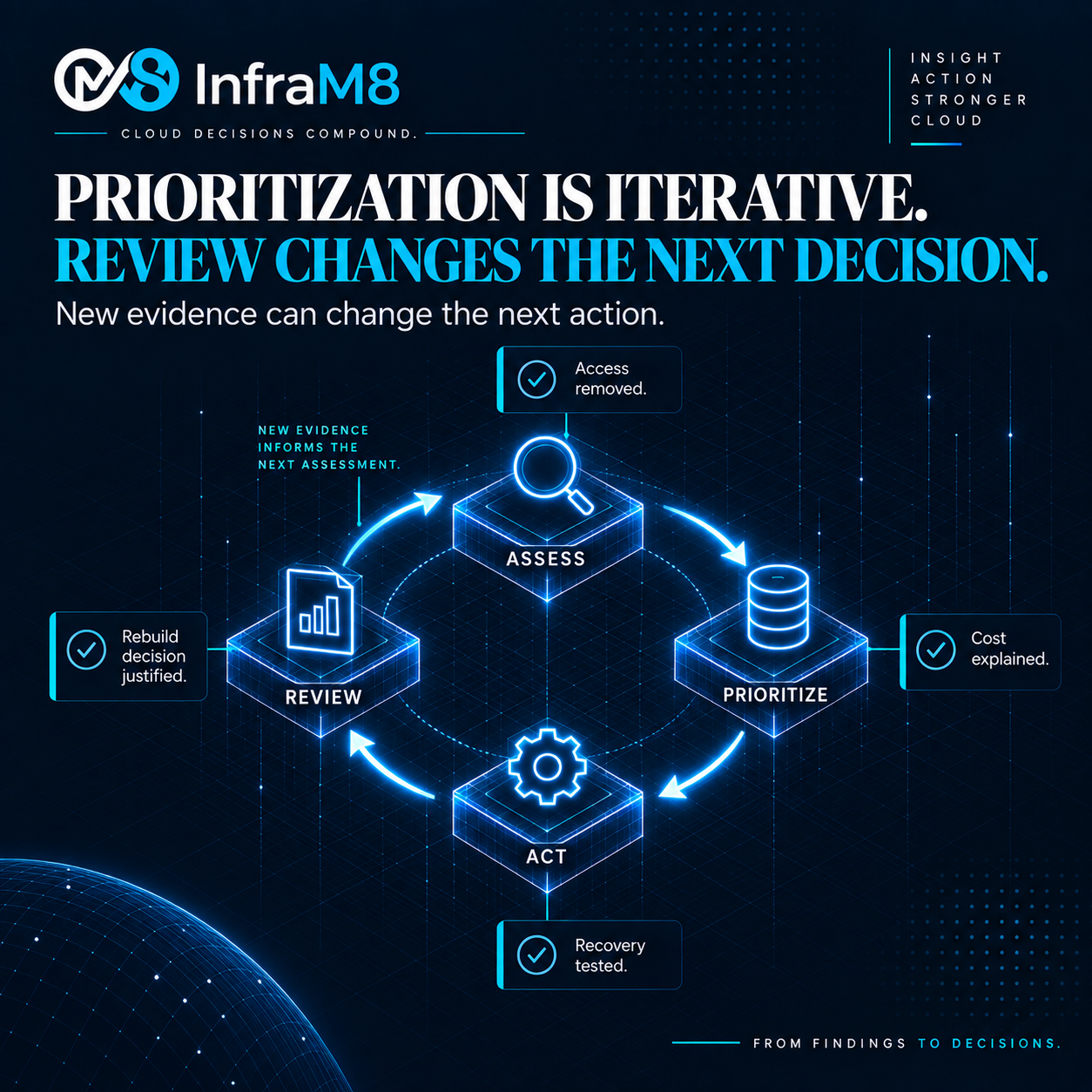
In this proposed approach, a useful review explains what requires action, what needs investigation, and what can wait. It also records what would change those decisions. Reviewing results may reopen an assessment or change the plan; the process is not a one-way guarantee of improvement.
The finding starts the conversation. The decision must explain what happens next.
References
- [1] Amazon Web Services. Prioritize improvements. AWS Well-Architected Tool User Guide. Official source.
- [2] National Institute of Standards and Technology. The NIST Cybersecurity Framework (CSF) 2.0. NIST CSWP 29, February 26, 2024. Section 3.1, printed pp. 6–7; GV.RR-02, printed p. 17; ID.RA-04 to ID.RA-07, printed p. 19. DOI: 10.6028/NIST.CSWP.29. Official publication.
- [3] FIRST. Common Vulnerability Scoring System v4.0: Specification Document. Introduction and Assessment. Official specification.
- [4] Amazon Web Services. SEC03-BP04 Reduce permissions continuously. AWS Well-Architected Framework, Security Pillar. Official guidance.
- [5] Amazon Web Services. Contain. AWS Security Incident Response User Guide. Official guidance.
- [6] Amazon Web Services. REL09-BP04 Perform periodic recovery of the data to verify backup integrity and processes. AWS Well-Architected Framework, Reliability Pillar. Official guidance.
- [7] FinOps Foundation. Anomaly Management. FinOps Framework. Official framework capability.
- [8] Thurgood, S., and Ferguson, D., with Hidalgo, A., and Beyer, B. Implementing SLOs. Chapter 2 in The Site Reliability Workbook. Google / O'Reilly, 2018. Official online chapter.
- [9] Joint Task Force Transformation Initiative. Guide for Conducting Risk Assessments. NIST SP 800-30 Rev. 1, September 2012. Sections 2.3.1–2.3.2, especially the treatment of uncertainty and assessment approaches on printed pp. 13–14. DOI: 10.6028/NIST.SP.800-30r1. Official publication. Official catalog record.
Sources rechecked on September 7, 2026. The cited NIST editions and the 2018 SRE book retain their original publication dates. AWS, FIRST, and FinOps web pages are referenced as living documentation without inventing a publication year. The access date is not the publication date of this article.