Cloud Foundations · · 14 min read
By Infram8
Is your cloud foundation ready for the next stage of growth?
A practical lens for founders and technical leaders before infrastructure becomes hidden risk. Architectural clarity should arrive before infrastructure decisions harden into operational drag.
Insight
Why this question matters
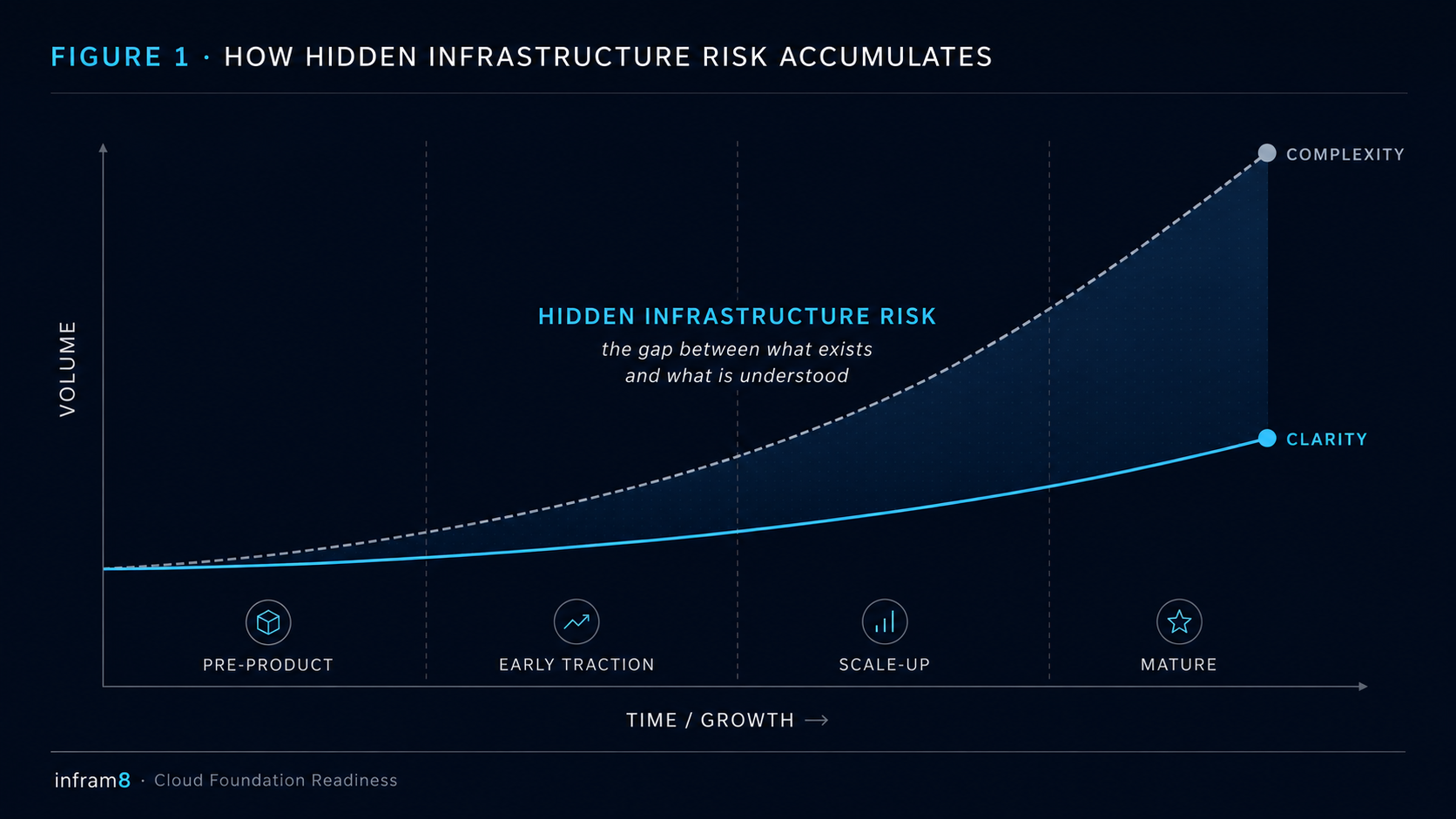
Many cloud problems do not start as major incidents. They start as small decisions that become invisible over time.
A resource created manually because the team needed to move fast. A security exception that was supposed to be temporary. An AWS account nobody fully understands anymore. A test environment that quietly became production-adjacent. A dashboard that shows data, but does not explain what should be done. A cloud bill that is visible, but not owned. A deployment pipeline that works, but is difficult to reproduce. A critical workload that depends on assumptions no one has reviewed recently.
None of these situations looks dramatic at first. But as the company grows, these small gaps start to create hidden infrastructure risk. The infrastructure may still be working. The product may still be available. The team may still be shipping. But confidence starts to weaken.
This is where cloud foundation readiness becomes important. Not as a heavy process. Not as a generic audit. Not as a list of tools. But as a practical way to understand whether the technical foundation of the company is ready for what comes next.
- What exactly exists in our cloud environment?
- Why does it exist, and who owns each workload, account, permission, cost, and operational decision?
- What is exposed, what is critical, and what can break first?
- What needs to be improved before the next stage of growth?
Section 02
Cloud readiness is not only about architecture diagrams
Architecture diagrams are useful. But they are not enough.
A diagram can show services, networks, databases, queues, clusters, environments, and integrations. It can help teams visualize structure. But cloud foundation readiness requires a broader lens. The AWS Well-Architected Framework identifies six foundational pillars - operational excellence, security, reliability, performance efficiency, cost optimization, and sustainability - as the dimensions every well-designed cloud workload must address.
A company can have a clean diagram and still have unclear ownership. It can have dashboards and still lack operational interpretation. It can have infrastructure automation and still depend on manual exceptions. It can use cloud-native services and still have weak security boundaries. It can track cost and still not understand what business value the cost supports.
There is a difference between an environment that looks ready and one that is actually ready:
| What looks ready | What is actually ready |
|---|---|
| A clean architecture diagram exists. | The team can explain the diagram, defend its trade-offs, and identify the riskiest paths. |
| The cloud bill is visible in a dashboard. | Each major cost line has an owner, a context, and a decision attached to it. |
| Cloud-native services are in use. | Critical exposures and permissions are known, reviewed, and reduced over time. |
| Dashboards and alerts are configured. | Signals reduce uncertainty; the team knows what to do when an alert fires. |
| Most resources run through Infrastructure as Code. | What remains manual is mapped, prioritized, and being closed deliberately. |
| The team is shipping fast. | Speed is protected by lightweight governance, not at risk of collapse from improvisation. |
A stronger cloud foundation connects architecture, cost, security, reliability, observability, automation, and governance. The point is not to make the environment perfect. The point is to make it understandable enough to support better decisions.
Before scaling, a team should be able to explain what exists, why it exists, who owns it, what it costs, what risk it creates, what is critical, what is fragile, and what should be improved first. That clarity changes the quality of technical decisions.
Section 03
The Cloud Foundation Review lens
A practical Cloud Foundation Review should not start with a shopping list of cloud services. It should start with the questions that reveal whether the foundation is clear, owned, secure, observable, reliable, reproducible, and governable.
At InfraM8, this lens is organized around eight dimensions.
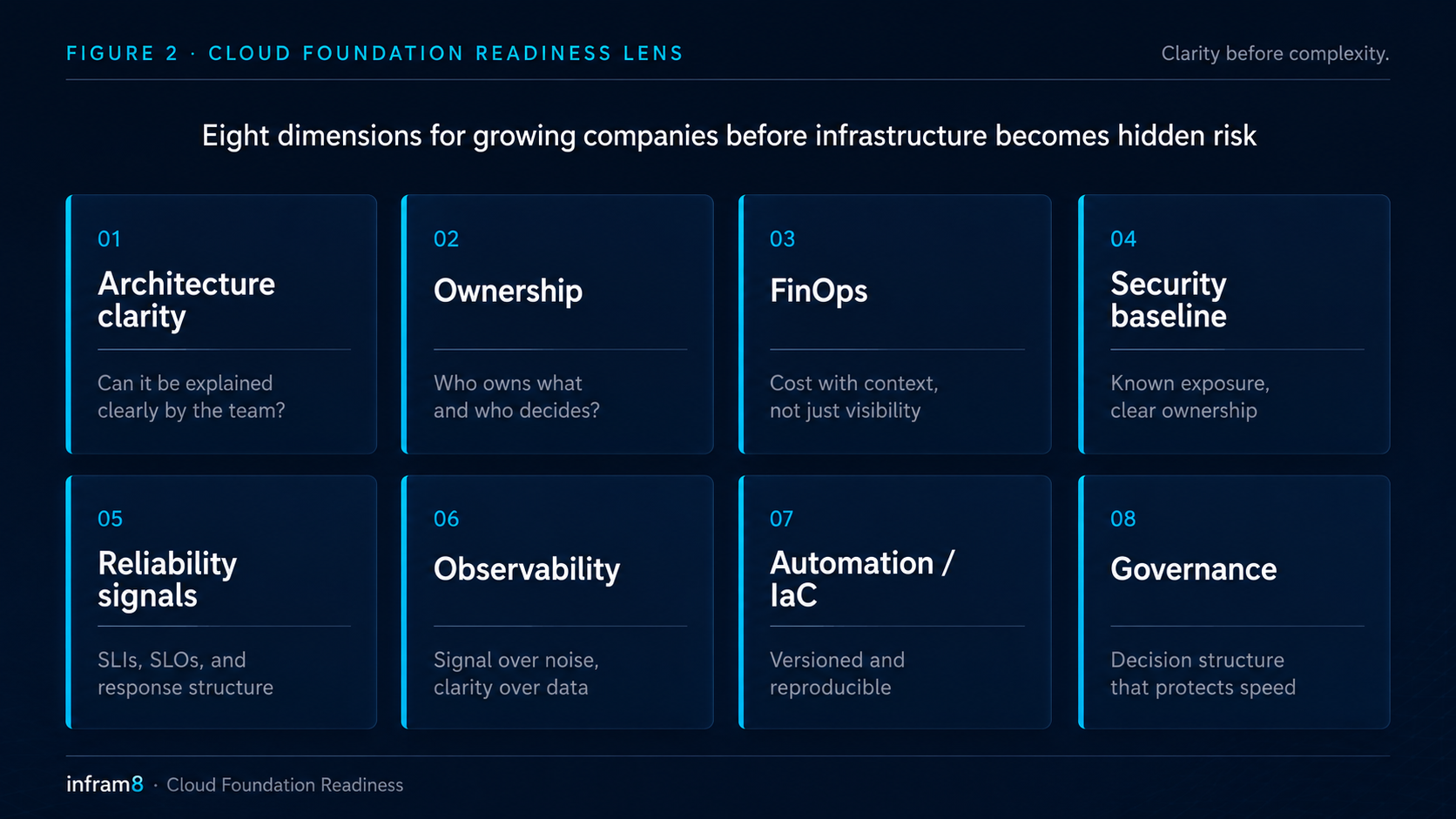
Eight dimensions at a glance
| # | Dimension | Core question | Key risk signal |
|---|---|---|---|
| 01 | Architecture clarity | Can the environment be explained clearly - workloads, flows, and critical paths? | Teams optimizing the wrong things; tools added before structure is understood. |
| 02 | Ownership | Who owns each workload, cost, permission, environment, and operational decision? | Ambiguity accumulates; changes become difficult; alerts become noise. |
| 03 | FinOps | Does cost have context, allocation, ownership, and connection to business value? | Reactive optimization; cost grows without clear understanding of what it supports. |
| 04 | Security baseline | Which exposures and permissions are known, reviewed, and owned? | Temporary exceptions become permanent; unknown exposure becomes operational risk. |
| 05 | Reliability signals | Are SLIs, SLOs, and response structures defined for critical flows? | Incidents without clear response structure; degradation goes undetected. |
| 06 | Observability | Does the team understand what is happening and know what to do next? | More dashboards, more noise - but less operational clarity. |
| 07 | Automation / IaC | What is still manual, fragile, undocumented, or difficult to reproduce? | Invisible dependencies; setups that cannot be reviewed or repeated. |
| 08 | Governance | How are important technical decisions made, reviewed, and changed? | Repeated improvisation; risk without structure; speed without context. |
01
Architecture clarity
The first question is simple: can the environment be explained clearly? Not only by one engineer. Not only by the person who built it. Not only through a collection of console views.
Architecture clarity means the team can explain the main workloads, environments, accounts, networks, data flows, dependencies, and critical paths. It does not mean every detail needs to be documented with excessive formality. It means the company has a shared understanding of how the environment works and where the main risks are.
When architecture is unclear, teams often optimize the wrong things. They add tools before understanding structure. They solve symptoms before understanding dependencies. They respond to incidents without knowing which flows are business-critical. Architecture starts before tools.
02
Ownership
Cloud environments become fragile when ownership is unclear. A resource without an owner becomes hard to change. A cost without an owner becomes hard to manage. A permission without an owner becomes hard to review. An alert without an owner becomes noise. A workload without an owner becomes operational risk.
Ownership is not only about assigning names. It is about creating accountability for decisions. Without that intent, cloud environments accumulate ambiguity, and ambiguity becomes expensive as the company grows.
03
Cost visibility and FinOps
Cloud cost visibility is useful, but it is not the same as ownership. A billing dashboard can show that cost increased. It does not always explain why the cost exists, who is responsible for it, whether it supports business value, or what decision should be made next.
Cost is an architectural concern, not only a billing issue. When cost has no context, optimization becomes reactive. When cost has ownership, teams can make better trade-offs. FinOps starts with ownership, not optimization.
04
Security baseline
Many security risks begin as exceptions. A permission added to unblock delivery. A public exposure that was supposed to be temporary. A broad role that nobody wants to change. A secret stored in the wrong place. A network rule that stayed open because nobody was sure what depended on it.
The question is not whether a growing company has security gaps. Most do. The better question is whether critical exposures and permissions are known, reviewed, and owned. Security by design starts with ownership and context - not with fear, and not with the promise of perfect protection.
05
Reliability signals
Reliability is not only uptime. It is the ability to understand whether the system is behaving well for the flows that matter most.
A growing company should know which user journeys, APIs, jobs, integrations, or internal flows are business-critical. From there, the team can define useful SLI and SLO structures, including error budgets that connect reliability decisions to release decisions. Dashboards show information. Reliability starts with definitions, not dashboards.
06
Observability
Observability is not the same as collecting data. Logs, metrics, traces, and alerts are useful only when they help the team understand what is happening and decide what to do.
A company can have many dashboards and still lack observability when signals are fragmented, alerts are noisy, traces are incomplete, or metrics are not connected to business-critical flows. Observability should reduce uncertainty. If it only increases noise, it is not creating operational clarity.
07
Automation and Infrastructure as Code
Manual infrastructure is sometimes necessary at the beginning. But manual infrastructure becomes risk when nobody can reproduce, review, or explain it. Infrastructure as Code helps teams make infrastructure visible, versioned, reviewable, and repeatable.
The important question is not only whether Infrastructure as Code exists. The better question is: what is still manual, fragile, undocumented, or difficult to reproduce? A cloud foundation review should look at provisioning, deployment flows, environment creation, configuration, secrets, permissions, and operational scripts. The goal is to identify which manual parts create the highest risk - not to automate everything at once.
08
Governance and decision structure
Governance is often misunderstood. In growing technical teams, governance should not mean heavy committees, slow approvals, or process for the sake of process. Good governance answers a simpler question: how are important technical decisions made, reviewed, and changed?
A company entering a new stage of growth needs enough structure to avoid repeated improvisation. That may include decision records, ownership rules, cloud account boundaries, cost review routines, security review checkpoints, reliability definitions, and architecture review practices. Too little governance creates hidden risk. Too much governance slows delivery. The right governance protects speed.
Signals worth investigating
| Dimension | Three signals worth investigating |
|---|---|
| Architecture clarity | Only one engineer can explain the environment end-to-end. Newcomers take months to feel safe shipping. Onboarding documents describe systems that no longer exist. |
| Ownership | Alerts go to a team that no longer exists. Resources have no tags or contradictory tags. A cost line item has been ignored for months because nobody knows whose it is. |
| FinOps | Monthly bill changes are unexplained. No one can answer "which product drives this cost?" Reserved capacity decisions are postponed indefinitely. |
| Security baseline | Public buckets, broad IAM roles, or stale exception lists. Secrets stored in source control or in chat. The phrase "we'll fix it later" appears in security review notes. |
| Reliability signals | Uptime is the only metric reported. Pages fire frequently and get acknowledged without action. There is no shared definition of what "healthy" means for the most critical flow. |
| Observability | A new incident requires building a new dashboard. Logs are searched manually under pressure. Traces are absent or incomplete on the user-facing path. |
| Automation / IaC | Production changes happen via the console regularly. "It works on staging" is a recurring debugging line. Recreating an environment from scratch is theoretical, not practiced. |
| Governance | The same architectural argument keeps re-emerging in different forms. Decisions are made in DMs and lost. There is no shared place to record what was decided and why. |
Section 04
A maturity model for cloud foundations
Cloud foundation readiness is rarely a binary state. Most growing companies have parts of the foundation that are mature and parts that are still ad hoc. That is normal. What is dangerous is not knowing which is which.
A useful way to think about each of the eight dimensions is on a four-level scale:
- Level 1 - Ad hoc. The dimension is handled informally, often by one person, with no shared definitions or routines.
- Level 2 - Defined. There is a baseline understanding and some documentation, but accountability is partial and inconsistent.
- Level 3 - Owned. There are clear owners, regular reviews, and decisions are recorded and revisited as the system evolves.
- Level 4 - Optimized. The dimension actively shapes decisions, is reviewed continuously, and feeds learning back into architecture and roadmap.
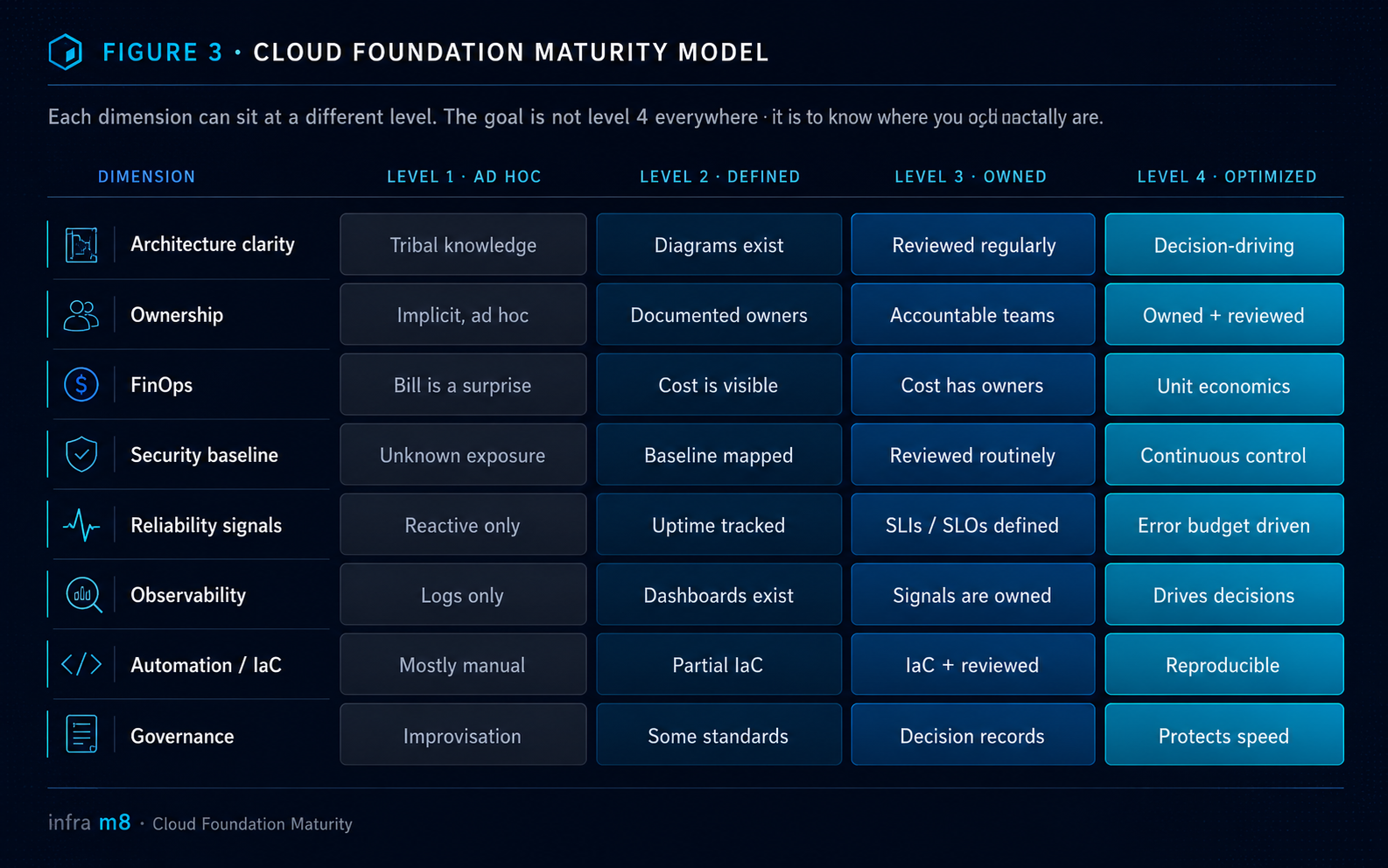
The goal is not to be at level 4 everywhere. That would be over-engineered for most growing companies, and would itself become a form of bureaucracy. The goal is to know where you are on each dimension, and to make explicit choices about which dimensions matter most for the stage you are entering.
A mixed profile - for example, level 3 on architecture clarity and ownership, level 2 on observability and reliability signals, and level 1 on FinOps - is normal and healthy when those choices are intentional. It becomes a problem when nobody can describe the profile, or when level-1 dimensions are quietly the ones the next growth stage will stress most.
Section 05
When to invest in foundation work
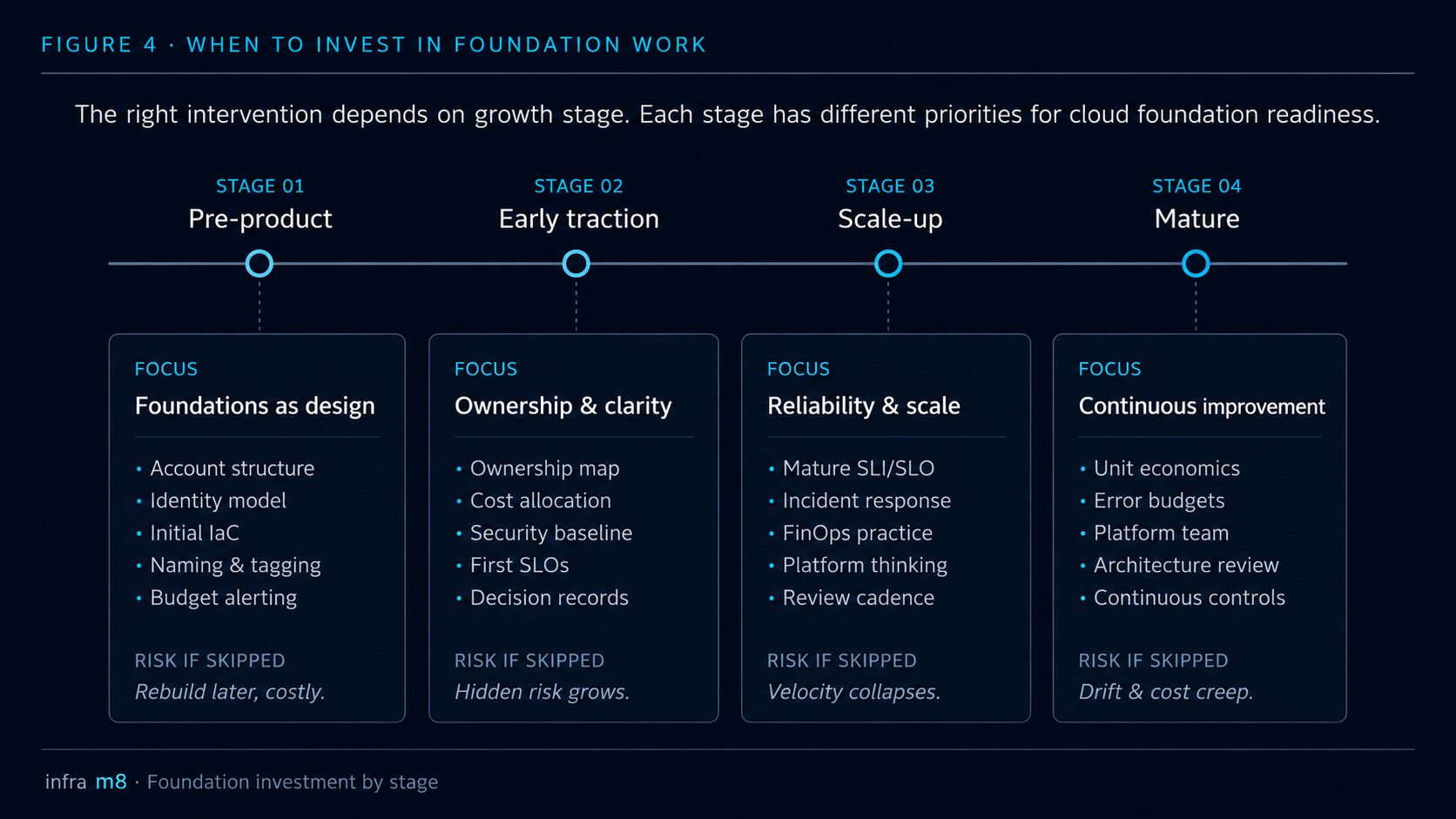
The right intervention depends on stage. The same review will land very differently in a pre-product team and a Series B scale-up. What looks like over-engineering at one stage looks like a missing prerequisite at the next.
Four broad stages have different priorities:
Stage 01 - Pre-product
A few engineers, no real customers yet, decisions made fast. The trap at this stage is over-engineering. The opposite trap, equally costly, is making structural decisions accidentally. Account structure, identity model, naming and tagging conventions, and a minimal amount of Infrastructure as Code are cheap to set up now and very expensive to retrofit later. The investment here is small but compound.
Stage 02 - Early traction
First real customers, first real cost, first real exceptions. This is where most hidden risk begins to accumulate. A simple ownership map, basic cost allocation by tags, a documented security baseline, and a first pass at SLOs for the most critical flow protect the team without slowing it down. Decision records start to matter because the same architectural argument is starting to come back in different forms.
Stage 03 - Scale-up
More teams, more environments, more cost lines, more dependencies. SLI and SLO discipline becomes more important. Incident response moves from heroic to structured. FinOps starts to operate as a real practice rather than a quarterly review. Architecture review becomes a routine, not a reaction. This is the stage at which not having a foundation review starts to show up in product velocity.
Stage 04 - Mature
The risk shifts from absence of structure to drift. Architecture review becomes continuous. Error budgets are real. FinOps connects to unit economics. A platform team begins to consolidate the patterns that work. The question is no longer "do we have a foundation?" but "is our foundation evolving as fast as our business?"
Section 06
How to start a Cloud Foundation Review
There is no single correct way to begin. But there is a useful starting point: stop adding tools and start asking questions. The questions below are the ones we find most diagnostic when working with growing teams. They are not exhaustive. They are designed to surface where the conversation needs to happen.
Ten questions for founders and technical leaders
- □Can someone outside the team that built it explain the production environment in fifteen minutes?
- □Does every workload, account, and major cost line have a clearly identifiable owner?
- □Could you answer, today, which three workloads drive most of your cloud cost - and why?
- □Do you have a current list of security exceptions, with owners and expected resolution dates?
- □Are there written SLIs and SLOs for at least your most business-critical user flow?
- □When an alert fires, does the responder know what to do, or do they need to figure it out?
- □If your most senior engineer left tomorrow, what would stop working that nobody else can fix?
- □Can you reproduce a production-equivalent environment from scratch, end to end?
- □When important technical decisions are made, are they recorded somewhere that can be revisited?
- □Do you know which of your eight dimensions is at level 1 today - and is that intentional?
If more than three of these questions take longer than a minute to answer with confidence, a structured review is likely worth the time it takes.
A practical first month often looks like this
- Week 1 - Build a current-state map: workloads, accounts, environments, owners, costs, and the most critical flows.
- Week 2 - Score each of the eight dimensions on the four-level maturity scale, with the team, in a single working session.
- Week 3 - Identify the three dimensions where moving up one level would most reduce risk for the next stage of growth.
- Week 4 - Define a focused improvement plan with owners, decision records, and a review cadence - not a 60-page document.
The output is not a report that sits on a drive. It is a shared understanding of the environment, an honest map of where the foundation is strong and where it is fragile, and a small number of decisions that protect the next stage of growth.
Section 07
Readiness does not mean bureaucracy
Cloud foundation readiness is not about making a growing company look like a large enterprise. It is not about slowing down product teams. It is not about turning every decision into a formal process. And it is not about replacing engineering judgment with templates.
The goal is different. Readiness is about giving the company enough clarity to move faster with less uncertainty.
There is a real distinction between governance that drags and governance that protects:
| Heavy governance | Designed governance |
|---|---|
| Approval boards for routine decisions. | Clear ownership for routine decisions; review only for high-impact ones. |
| Policies written once, rarely revisited. | Lightweight standards reviewed on a known cadence. |
| Compliance treated as paperwork. | Compliance designed into the platform and made automatic where possible. |
| Decision-making centralized in one person. | Decisions distributed by domain, recorded so they can be questioned later. |
| Bureaucracy added in response to incidents. | Structure designed before crisis, light enough to survive growth. |
| Slows the fast teams to protect the slow ones. | Protects the fast teams by reducing repeated improvisation. |
A founder does not need every technical detail. But they do need to understand where the foundation is strong, where it is fragile, and where risk is increasing. A CTO does not need unnecessary bureaucracy. But they do need a clear view of what should be improved before the next stage of growth. An engineering team does not need more meetings. But it does need ownership, visibility, reliable signals, and infrastructure that can be reproduced and explained.
Cloud governance protects speed
Good governance helps teams avoid the cost of repeated improvisation. It helps leaders prioritize. It helps engineering focus on the improvements that matter most. Not every problem needs to be solved at once. But the most important problems should be visible.
Before scaling, understand what can break first.
Section 08
Where InfraM8 helps
InfraM8 helps startups and growing companies create architectural clarity before cloud foundations become hidden risk.
The work does not start with a list of tools. It starts with the environment, the decisions behind it, the risks that are becoming harder to see, and the growth stage the company is preparing for.
A focused Cloud Foundation Review can help clarify:
- What is strong, what is fragile, what is unclear.
- Where ownership is missing or contradictory.
- Which costs lack context and which exposures are unknown.
- Which reliability signals are absent on the flows that matter most.
- What is manual today that should be reproducible tomorrow.
- What governance is needed to protect speed at the next stage.
For growing companies, this kind of review can create a clearer path before adding more complexity. Not every problem needs to be solved at once. But the most important problems should be visible.
Strategic conversations are open
If the next stage of growth will stress your cloud foundation, the useful starting point is a focused review of architecture clarity, ownership, risk, cost, reliability, and governance.
References
- Beyer, B., Jones, C., Petoff, J., & Murphy, N. R. (2016). Site Reliability Engineering: How Google Runs Production Systems - Chapter 4: Service Level Objectives. Google / O'Reilly Media.
- Thurgood, S., & Ferguson, D., with Hidalgo, A., & Beyer, B. (2018). The Site Reliability Workbook - Chapter 2: Implementing SLOs. Google / O'Reilly Media.
- FinOps Foundation (2024). What is FinOps?
- FinOps Foundation (2024). FinOps Framework Principles - Everyone Takes Ownership for Their Technology Usage.
- Amazon Web Services (2024). AWS Well-Architected Framework.
- DORA Research Team (2024). 2024 Accelerate State of DevOps Report. Google Cloud / DORA.
- CNCF TAG Observability (2023). Observability Whitepaper v1.0. Cloud Native Computing Foundation.
- Forsgren, N., Humble, J., & Kim, G. (2018). Accelerate: The Science of Lean Software and DevOps. IT Revolution Press.
- Skelton, M., & Pais, M. (2019). Team Topologies: Organizing Business and Technology Teams for Fast Flow. IT Revolution Press.