Edge AI · · 18 min read
By Infram8
When Infrastructure Learns at the Edge
TinyML, Deep Learning, and the architecture of distributed intelligence. A strategic perspective on what changes when part of inference moves closer to sensors, devices, gateways, and physical environments.
Insight
Introduction
Modern infrastructure is becoming less centralized. Sensors, devices, gateways, and embedded systems are no longer limited to collecting raw data for centralized interpretation. As local inference becomes technically viable on constrained hardware, part of the decision-making layer can move closer to the physical systems being monitored.
This matters because many infrastructure environments are not purely digital. They involve heat, vibration, air quality, energy loads, traffic, buildings, machinery, patients, and networks operating under real-world constraints. Connectivity can be intermittent. Bandwidth can be expensive. Latency can affect the usefulness of a response. Privacy can limit what data should leave a device. In these contexts, cloud-only Artificial Intelligence (AI) can still be valuable, but it is not always sufficient.
Tiny Machine Learning (TinyML) and Deep Learning (DL) sit at the center of this architectural shift. TinyML enables running Machine Learning (ML) models on microcontrollers and other resource-constrained devices, often under strict limits on memory, compute, Flash storage, and power consumption. Deep Learning can be useful because many sensor streams are noisy, temporal, and contextual. At the same time, not every sensor problem requires a deep model. The architectural question is not simply which model is most accurate, but where inference should occur, what the device can support, and how the system will be governed in operation.
The answer is not "edge" instead of "cloud." The cloud remains essential for model training, long-term storage, fleet management, analytics, integration, and governance. A more useful framing is the distribution of responsibility. Intelligent infrastructure requires a clear separation of roles across the device, edge, and cloud layers, with robust controls for observability, security, lifecycle management, bounded autonomy, and accountability.
This shift is also physical. It depends on a hardware spectrum ranging from ultra-low-power Microcontroller Units (MCUs) to more capable edge gateways that aggregate and coordinate multiple sensor nodes. Understanding the hardware layer makes Edge AI concrete. It prevents teams from treating the edge as a vague location and forces clearer decisions about what each layer can realistically do.
Section 01
Intelligence is moving closer to where data is created
Cloud-centric architectures have shaped much of modern AI and infrastructure engineering. They remain powerful because centralized platforms provide scalable compute, managed storage, global analytics, model training environments, integration services, and governance controls. For many workloads, sending data to the cloud is still the right decision.
The limitation becomes apparent when the system depends on the physical timing and local context of an event. A vibration anomaly in an industrial motor, a sudden air-quality spike in a street corridor, a signal change in a wearable device, or an abnormal network pattern may lose value if the response depends entirely on round trips to a remote platform. The issue is not only latency. It also includes the volume of data that must be transmitted, the cost of moving continuous raw signals, the reliability of connectivity, and the governance risk of sending sensitive data upstream by default.
This is why distributed intelligence is increasingly relevant. By placing inference closer to where data is produced, a system can classify signals locally, filter noise before transmission, trigger local alerts, or continue operating when connectivity is limited. In infrastructure settings, this can shift a system from passive recording to timely local response.
Closer to the data does not always mean the smallest device. It can mean an MCU, a field sensor node, a local gateway, an edge server, or a small local compute layer. The right placement depends on the decision being made, the data being processed, the required response time, the privacy constraints, and the operational model.
TinyML literature describes this movement as part of a broader push to bring inference to embedded and Internet of Things (IoT) endpoints, enabled by advances in algorithms, compilers, hardware, and system design [1]. Reviews of ultra-low-power TinyML also emphasize latency, bandwidth, energy, cost, and intermittent connectivity as key drivers for moving selected analytics closer to IoT nodes [2]. For infrastructure leaders, the implication is clear: intelligence placement is now an architectural decision, not merely a model deployment detail.
Section 02
TinyML is not just smaller AI
TinyML is often introduced as machine learning on microcontrollers, but that definition can sound too narrow. The more important point is that TinyML changes where inference can occur. It enables constrained devices to participate in a system's intelligence layer rather than acting only as raw-data emitters.
Microcontroller-class environments impose constraints that differ from those of cloud, server, or even mobile AI. Available Random Access Memory (RAM) may be measured in kilobytes or a few megabytes. Flash storage is limited. Power budgets may be extremely tight, especially for battery-operated sensors. Some devices run without a general-purpose operating system. Memory allocation may need to be static. Operator support can be limited. The model must fit not only the problem but also the runtime, compiler, board, sensor interface, firmware lifecycle, and update mechanism.
This is why TinyML is not only about compressing a trained neural network. It requires co-design across the model, firmware, hardware, and deployment stack [1]. Quantization can reduce precision from floating-point to integer formats, lowering memory and compute requirements. Pruning can remove less useful parameters. Optimized kernels, such as CMSIS-NN for Arm Cortex-M CPUs, can improve neural network execution on embedded processors [18]. Toolchains such as TensorFlow Lite for Microcontrollers and LiteRT for Microcontrollers exist because deployment in bare-metal or minimal-runtime environments requires a different execution model from conventional AI platforms [16], [17]. Edge Impulse and similar workflows demonstrate how signal processing, model design, and embedded deployment can be packaged into a practical development flow [19].
A model architecture that relies on unsupported operators, dynamic memory behavior, or runtime features unavailable on the target device may be difficult to deploy, even if its parameter count is small. This is one reason TinyML cannot be treated as a late-stage optimization step. Device, runtime, operators, sampling strategy, and firmware constraints shape what is possible from the start.
The architectural consequence is that TinyML becomes part of infrastructure design. A team must decide how much intelligence to place on the device versus at a gateway, which data to summarize before transmission, how to track model versions, how to deliver updates, and how to observe local decisions. These decisions are not afterthoughts. They shape reliability, cost, privacy, and operational ownership.
Section 03
The hardware layer: devices that make edge intelligence possible
TinyML and Edge AI are not abstract software concepts. They depend on a physical compute layer. The device class selected for a system determines what can be inferred locally, how often a model can run, how much data can be buffered, which update mechanisms are feasible, and what kind of observability can be expected in the field.
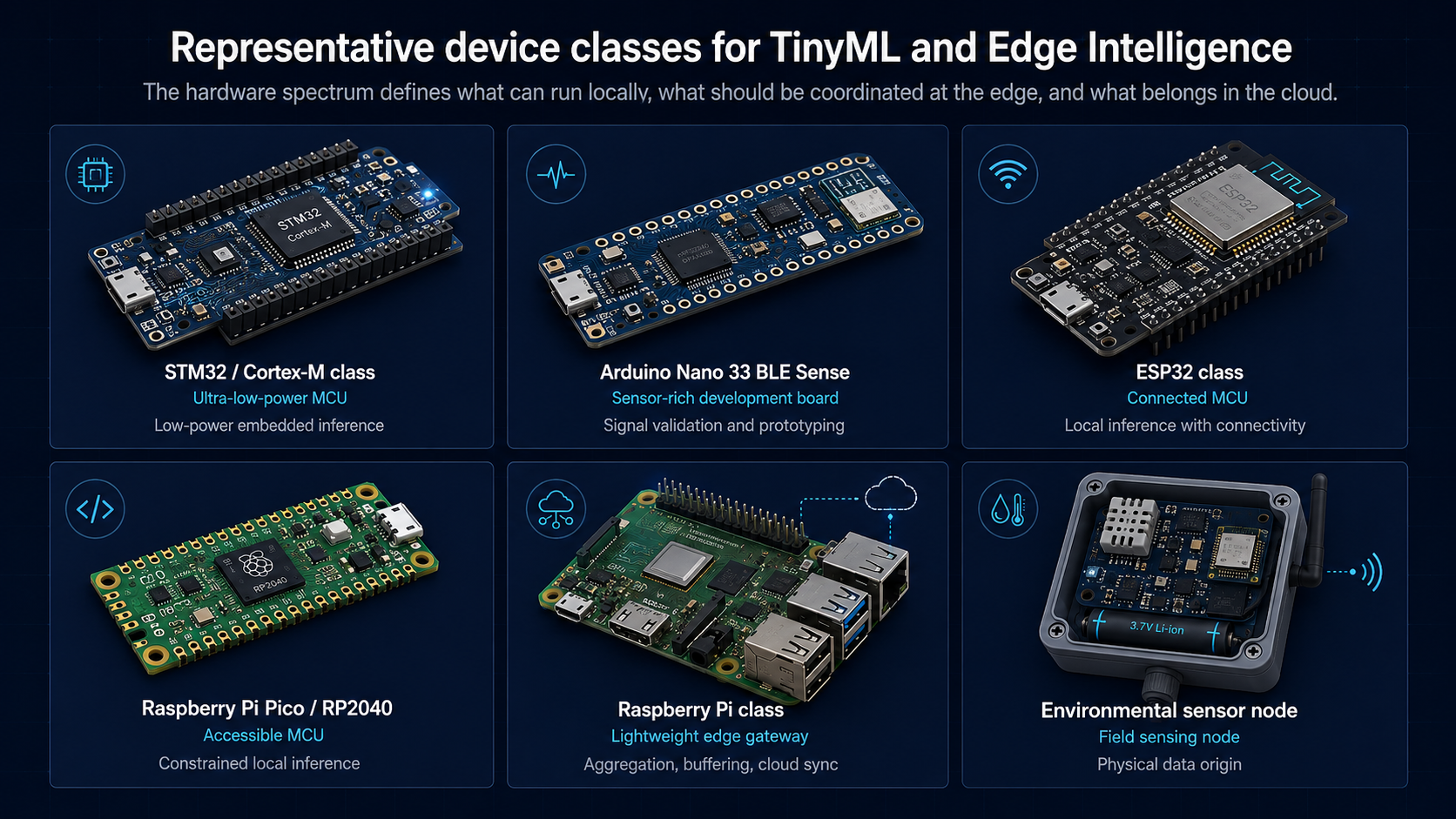
At the smallest end of the spectrum are MCUs for ultra-low-power local inference. Boards based on STM32, ESP32, or Raspberry Pi Pico/RP2040 are representative of this category. STM32-class devices exemplify Cortex-M MCU systems that can support efficient embedded inference with optimized kernels. ESP32-class boards are connected MCUs that can pair local inference with Wi-Fi, Bluetooth Low Energy (BLE), or IoT connectivity. Raspberry Pi Pico/RP2040-class boards are accessible MCU platforms for compact inference and experimentation. These are not interchangeable devices, but they help illustrate the range of constraints in low-power embedded AI.
These boards should be viewed as representative device classes, not as default production choices. Production deployments typically require decisions on enclosure, power regulation, environmental protection, calibration, secure provisioning, maintainability, and fleet management. A development board can validate a signal and a model. A reference board can inform an architecture. A production board must withstand the operational environment.
Sensor-rich development boards, such as the Arduino Nano 33 BLE Sense, serve a different purpose. They connect model development to physical signals via onboard sensors for motion, sound, and environmental inputs. Their value is greatest in prototyping and early-stage TinyML pipelines because they make it easier to test whether a signal contains enough structure to justify local inference. The caution is that a proof-of-concept board may hide production questions: sensor calibration, power design, enclosure, physical security, update strategy, and long-term maintainability.
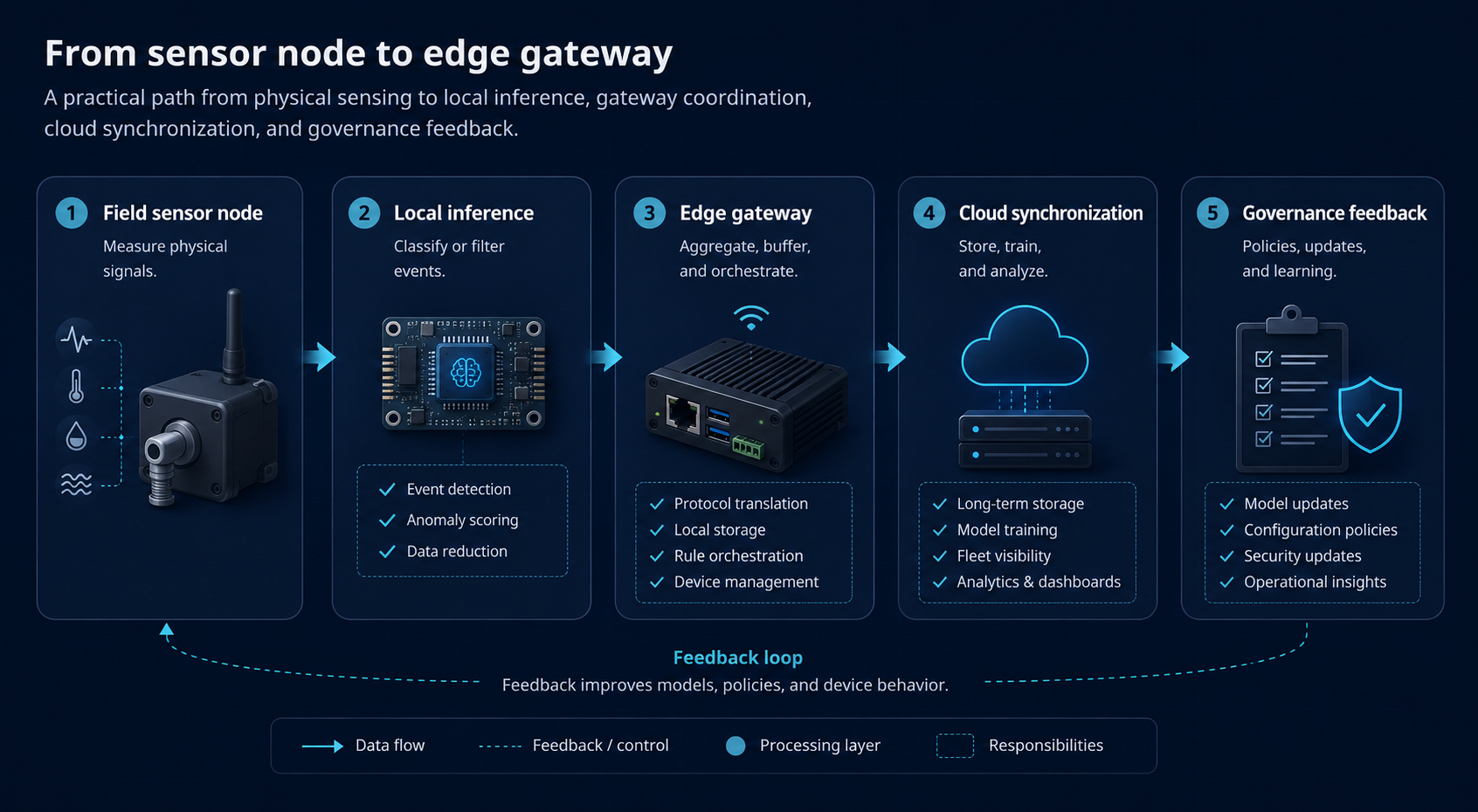
Edge gateways and lightweight Linux devices, such as a Raspberry Pi used as a gateway, sit between constrained nodes and cloud systems. They can aggregate data from multiple sensors, buffer data when connectivity is unstable, translate protocols, perform heavier preprocessing, coordinate local actions, and synchronize selected events with the cloud. In many intelligent infrastructure systems, the gateway is where local context becomes operational. A sensor node can classify its own signal; a gateway can compare signals across rooms, machines, building zones, or network segments.
Field sensor nodes make the architecture tangible. A node that measures temperature, humidity, air quality, vibration, light, current, or acoustic patterns is where physical reality becomes data. Adding TinyML transforms the node from a passive measurement point into a constrained local inference point. The architecture must then specify which local interpretations are safe, which require escalation, which should be confirmed by a gateway, and which should be sent to the cloud for historical analysis or governance.
Hardware selection is therefore architecture selection. An MCU favors low-power local inference and minimal telemetry. A connected MCU adds synchronization options but also expands the attack surface. A sensor-rich board supports exploration and signal validation. A field sensor node introduces requirements for calibration, enclosure, power, and maintainability. A gateway supports aggregation, coordination, and richer local operations. The cloud remains the place for training, global analytics, governance, and integration. A mature Edge AI architecture makes these roles explicit rather than assuming the edge is a single location.
Section 04
Sensor data changes the model architecture discussion
Sensor data is rarely clean, isolated, or context-free. It is often sequential, noisy, irregular, and dependent on physical conditions. Temperature, humidity, carbon dioxide (CO2), vibration, current, acoustic patterns, electrocardiogram (ECG) signals, network usage, and air quality measurements are more meaningful when interpreted over time and in relation to other signals. This is where Deep Learning may add value to sensor-heavy systems: it can learn patterns for classification, regression, anomaly detection, forecasting, and representation learning.
But a model that performs well in a notebook may not be viable on a microcontroller. Edge deployment shifts the model-selection discussion. RAM, Flash, inference latency, energy consumption, supported operators, numerical precision, firmware coupling, and update frequency matter alongside accuracy. At the edge, the best model is the one that fits the signal, the device, and the operational requirement.
Recurrent Neural Networks (RNNs), Long Short-Term Memory (LSTM) networks, and Gated Recurrent Units (GRUs) are important families of models for sequential data because they capture temporal dependencies. They are still suitable when understanding long-range context is crucial and the deployment environment can handle their computational demands. However, in resource-limited devices, their memory usage and latency can be significant issues. Hardware-aware studies comparing LSTMs and one-dimensional Convolutional Neural Networks (1D-CNNs) on such devices indicate that 1D-CNNs may be more practical for specific time-series classification tasks, as they require fewer resources while still providing competitive performance in benchmark tests [4]. Additionally, reviews of TinyML time-series systems emphasize that classification methods must consider latency, energy consumption, and device limitations [3].
This does not mean 1D-CNNs are always better. It means architecture teams need to match model structure to signal characteristics and device constraints. A 1D-CNN may be efficient when local temporal patterns are sufficient. An LSTM may be justified when longer dependencies are central and resources allow. In some systems, careful signal processing, thresholds, or classical ML may outperform a larger neural architecture once deployment cost, explainability, and maintenance are considered.
The deeper lesson is that model and hardware selection are coupled. A device with limited RAM may favor compact feature extraction and short windows. A gateway may support larger windows, richer preprocessing, or ensemble logic. A cloud service may still be required for training, global comparison, and long-term improvement. In Edge AI, model architecture is system architecture.
Model Selection Considerations for Resource-Constrained Devices
| Model family | Typical use case | Strengths | Limitations on MCUs | Device fit | Architecture implication |
|---|---|---|---|---|---|
| RNN / LSTM / GRU | Sequences where long-range temporal context is essential and resources allow. | Strong temporal memory; useful when past context strongly shapes current interpretation. | Higher RAM, Flash, latency, and energy pressure; quantization and operator support can be harder. | Better suited to gateways or capable MCUs when the temporal value justifies the cost. | Use only when temporal memory is worth the operational complexity. Avoid treating recurrent models as the default for edge. |
| 1D-CNN | Local temporal patterns in sensor streams, classification, anomaly flags, and compact feature extraction. | Efficient convolution over time windows; often lower latency and easier parallelization. | May miss long-range dependencies without careful windowing or architecture design. | Often suitable for MCUs or gateways when window size and operator support fit the device. | A strong baseline for TinyML time-series problems where local patterns are sufficient. |
| TinyML-optimized classical ML | Simple classification or regression, limited datasets, interpretable rules, and very constrained devices. | Low footprint, fast inference, easier explanation, simpler deployment. | Lower capacity for complex nonlinear patterns; may require feature engineering. | Well suited to ultra-low-power MCUs, rule-based nodes, or systems with strict explainability needs. | Prefer when the problem is simple, resources are tight, and maintainability matters more than model complexity. |
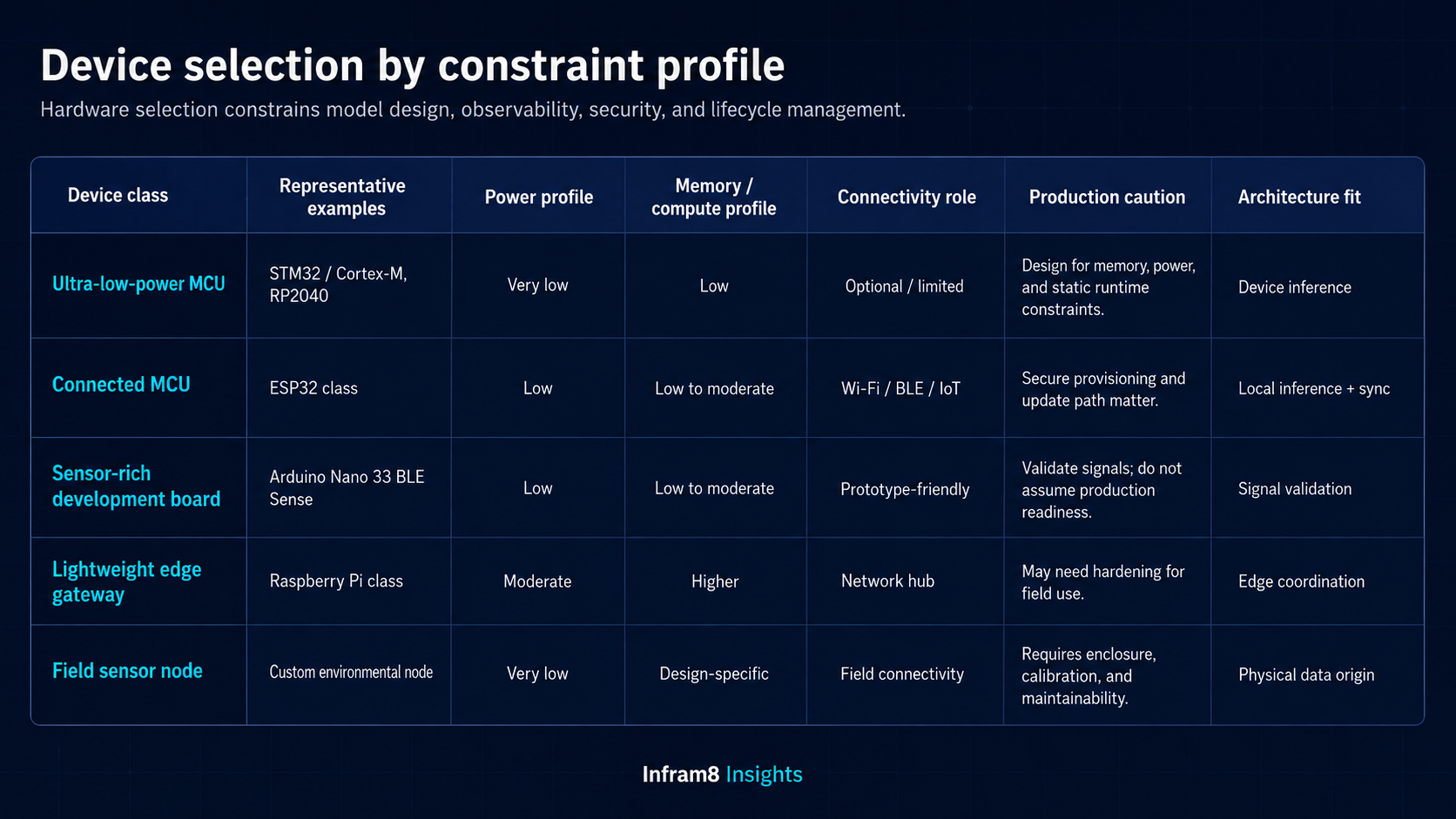
Device Selection by Constraint Profile
| Device class | Representative examples | Power profile | Memory / compute profile | Connectivity role | Best use case | Production caution | Architecture fit |
|---|---|---|---|---|---|---|---|
| Ultra-low-power MCU | STM32 / Cortex-M, Raspberry Pi Pico / RP2040 | Very low | Low | Optional or limited | Compact local inference, simple anomaly detection, battery sensing | Design for memory, power, static runtime, and firmware constraints. | Device inference |
| Connected MCU | ESP32 class | Low | Low to moderate | Wi-Fi, BLE, or IoT protocols | Connected sensing, local inference with periodic sync | Secure provisioning, credential handling, and OTA strategy matter. | Local inference plus synchronization |
| Sensor-rich development board | Arduino Nano 33 BLE Sense | Low | Low to moderate | Prototype friendly | Signal validation, model exploration, sensor-rich proof of concept | Do not confuse prototype convenience with production readiness. | Bridge from signal discovery to architecture |
| Lightweight edge gateway | Raspberry Pi class, small Linux gateway | Moderate | Higher | Network hub | Aggregation, buffering, preprocessing, protocol translation | May require industrial hardening, security controls, and managed updates. | Edge coordination |
| Field sensor node | Custom environmental, building, or industrial node | Very low to low | Design-specific | Field connectivity, often intermittent | Physical data origin for environmental, urban, building, or industrial sensing | Requires enclosure, calibration, maintainability, secure provisioning, and lifecycle planning. | Physical origin of intelligence |
Section 05
The distributed stack: sensor, edge, cloud, and governance
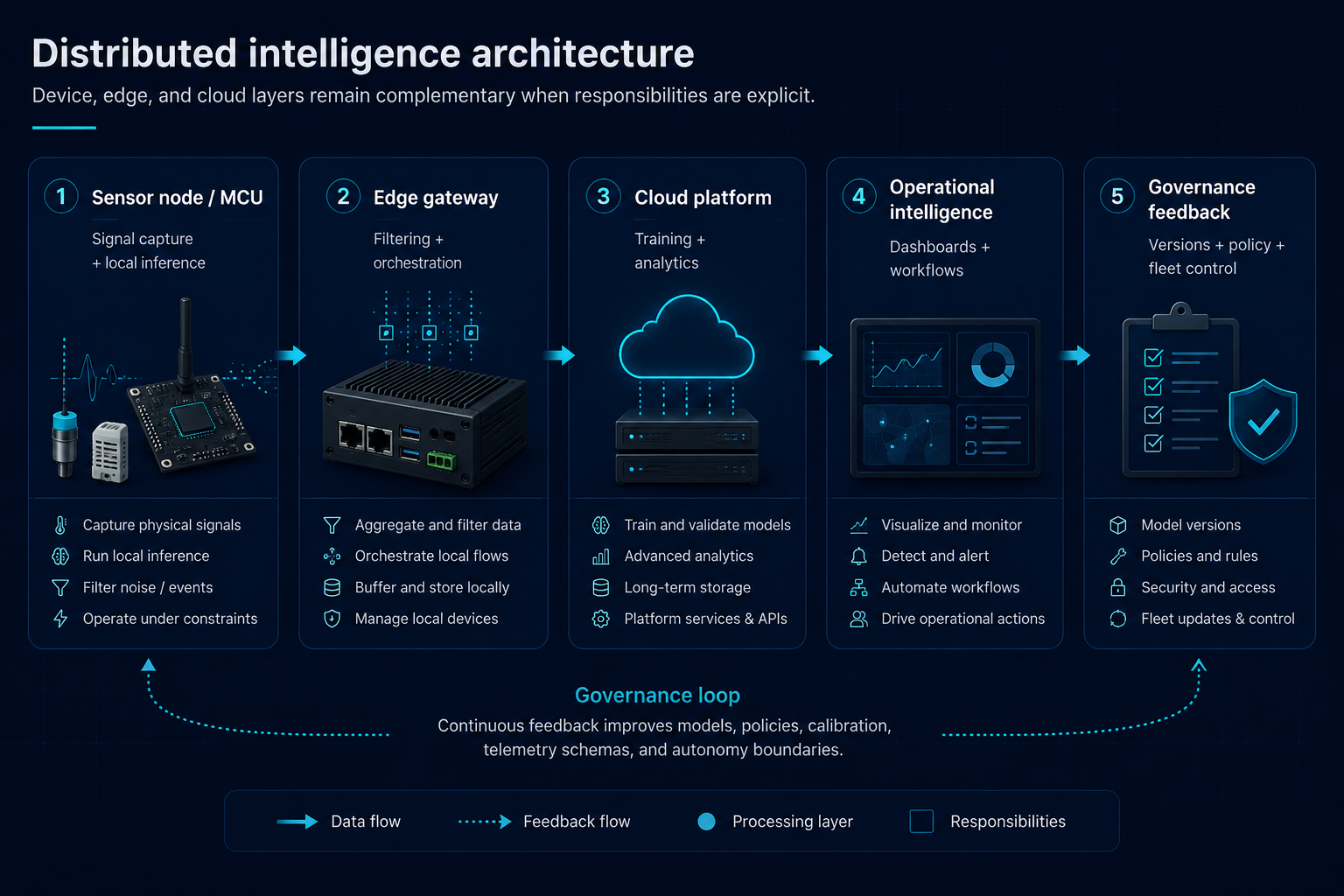
A mature Edge AI architecture is not created by placing models wherever deployment is technically feasible. It is created by deliberately assigning responsibilities across the sensor node or MCU, the edge gateway, the cloud platform, and the governance loop that connects them.
The sensor node detects real-world signals, captures physical data, and may perform local inference when resources allow, especially when rapid, privacy-conscious, or bandwidth-sensitive decisions are needed. The edge gateway handles filtering, aggregation, enrichment, and orchestration, combining signals from multiple devices, applying local rules, buffering temporarily, coordinating actions, and ensuring continuity during cloud disconnections. The cloud platform is crucial for training, historical analysis, dashboards, fleet management, governance, integration, and storing data long-term.
Governance must integrate all three layers. Policies, model versions, calibration rules, update expectations, telemetry schemas, and safety boundaries should be communicated back to devices and gateways. Conversely, devices and gateways need to send sufficient telemetry data for monitoring, auditing, drift detection, and operational enhancements. Without this feedback loop, trust in edge intelligence is compromised.
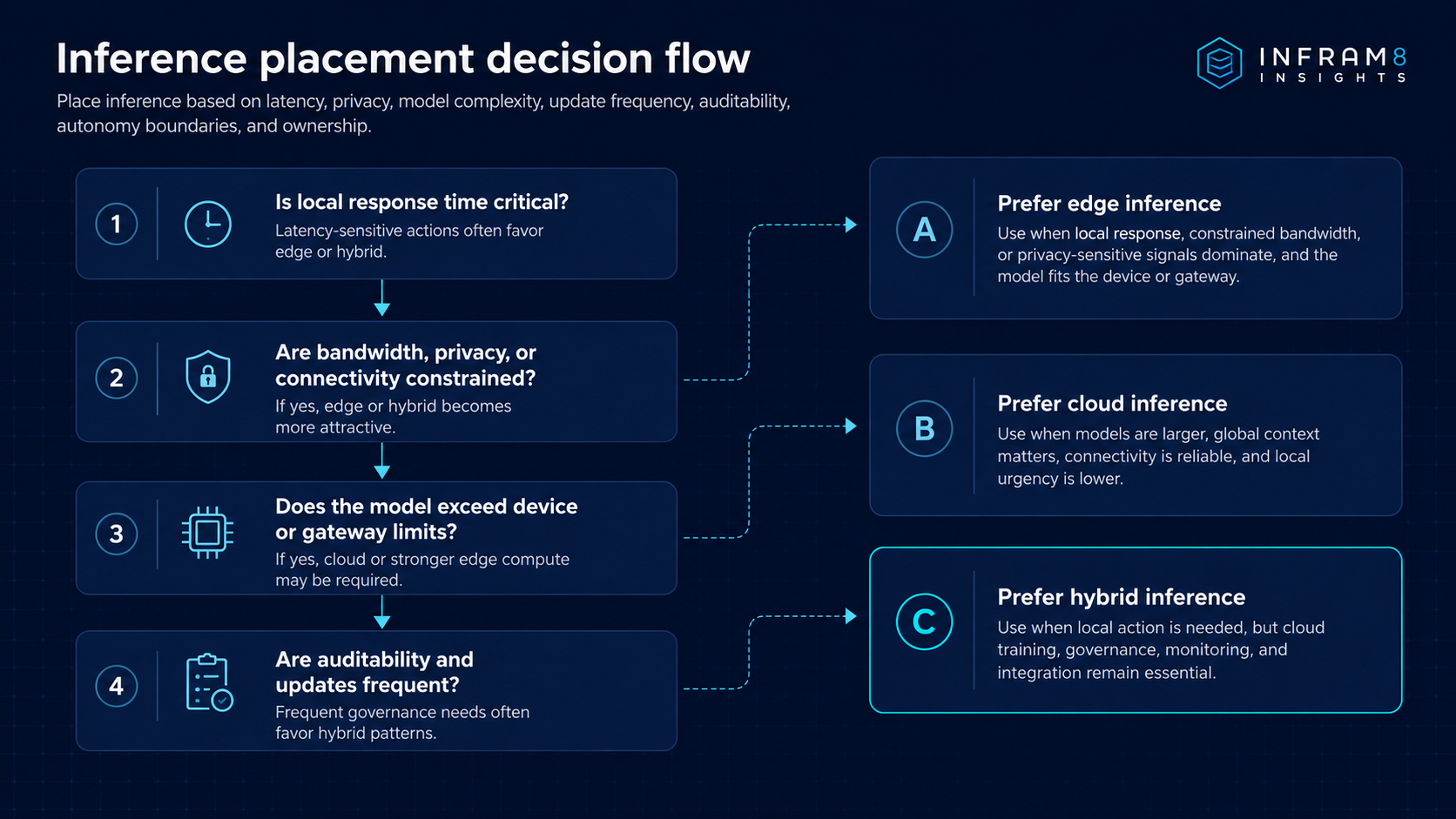
Edge AI architecture surveys often refer to a system as layered or collaborative, rather than focusing on a single deployment point [7], [8]. The key issue is not whether inference should be centralized or decentralized, but rather which tasks should be assigned to each location. Cloud inference is appropriate for complex models, global optimization, batch analytics, and scenarios where latency is not a concern. Conversely, edge inference works well for immediate local responses, privacy-sensitive data, disconnected environments, or bandwidth savings. Although hybrid inference is commonly used in practice, it is not always necessary. It becomes especially useful when local actions need to coordinate with centralized learning, governance, monitoring, or integration.
Cloud Inference vs Edge Inference vs Hybrid Inference
| Dimension | Cloud inference | Edge inference | Hybrid inference |
|---|---|---|---|
| Best suited for | Complex models, global optimization, batch analytics, centralized governance. | Local response, privacy-sensitive signals, offline or bandwidth-constrained operation. | Systems that need local decisions plus centralized learning, monitoring, and governance. |
| Latency profile | Network-dependent; suitable when response time is less critical. | Low local latency when model fits device constraints. | Low latency for local decisions, cloud latency for broader analysis. |
| Bandwidth impact | Can be high if raw streams are transmitted. | Lower if only events, summaries, or confidence signals are sent. | Moderate; raw data can be sampled while routine signals are filtered. |
| Connectivity dependency | High for inference availability. | Lower for local behavior, but updates and monitoring still depend on connectivity. | Moderate; local operation continues while cloud sync may degrade. |
| Privacy considerations | More data leaves the device, requiring stronger cloud controls. | Sensitive data can remain local when designed correctly. | Sensitive data can be minimized while useful metadata reaches the cloud. |
| Operational complexity | Centralized systems are easier to monitor but can become expensive at scale. | Distributed lifecycle, heterogeneous devices, and update management are harder. | Requires clear contracts between device, edge, and cloud responsibilities. |
| Typical risks | Bandwidth cost, latency, overcentralization, broader data exposure. | Device compromise, drift, limited observability, firmware/model mismatch. | Ambiguous ownership, inconsistent governance, complex troubleshooting. |
| Governance needs | Access control, data governance, model registry, compliance. | Device identity, signed updates, local auditability, model lifecycle. | End-to-end governance across models, telemetry, updates, and ownership. |
| Architecture implication | Best when central context matters more than local immediacy. | Best when local context and response matter more than global computation. | Common when local action and centralized learning must reinforce each other. |
Section 06
Where edge intelligence becomes useful
Edge intelligence becomes useful when local context changes the value of the system. The strongest use cases are defined not by the presence of sensors but by the value of acting on local context, with clear governance.
Environmental and urban sensing serve as a clear example. A city, campus, or facility can gather data on temperature, humidity, air quality, PM2.5, CO2, noise, and traffic from multiple locations. The typical setup involves an MCU-based sensor node supported by a gateway when coordination among many nodes is required. Local inference can identify abnormal patterns, detect sensor anomalies, or classify short-term risk signals, then send summarized events to a central platform. The cloud remains responsible for analyzing historical data, cross-location correlations, dashboards, and model governance. In smart-city TinyML research, these patterns relate to limited connectivity, LPWAN environments, environmental monitoring, traffic management, and energy applications [10], [15]. Potential issues include over-filtering locally, which may eliminate diagnostic information needed later for calibration, incident review, or model updates.
Industrial predictive maintenance provides a compelling example. Signals like vibration, sound, temperature, current, and pressure can reveal changes in equipment performance. Transmitting all high-frequency raw data to the cloud might be costly or operationally difficult. A sensor node can collect the data, with a local processor or gateway analyzing patterns, detecting anomalies, or initiating inspection workflows. Meanwhile, the cloud can handle fleet-wide analytics, asset history, model training, and maintenance planning. Current work on TinyML in predictive maintenance supports this application, emphasizing that deployment constraints are key considerations [9]. Potential issues include overconfidence in local models, which could delay human inspections if model drift, calibration, or sensor health are not properly monitored.
Smart buildings and energy systems illustrate how edge intelligence enables localized control. These buildings generate data on occupancy, temperature, humidity, light, air quality, HVAC operation, and energy consumption. The typical hardware setup involves distributed nodes linked to a building gateway, with cloud analytics used for long-term optimization. Local inference helps categorize energy loads, identify abnormal usage, and support control strategies tailored to specific zones. Muthusamy et al. demonstrate TinyML's application in smart industry power-load classification, highlighting how embedded inference can aid load classification in industrial energy management [11]. However, issues like poor calibration or weak telemetry can create a false sense of successful local optimization, potentially leading to reduced comfort, efficiency, or auditability over time.
Network and operational telemetry are particularly important for infrastructure teams. Devices like routers, gateways, and edge systems produce large amounts of usage and performance data. TinyML can help identify abnormal patterns, predict local demand, or minimize telemetry noise before sending data to central observability platforms. Typically, the hardware in this scenario is an edge device or gateway, not a small battery-powered node. The University of Oulu's thesis on edge-enhanced network monitoring using TinyML is relevant, as it links TinyML directly to network monitoring and operational tools [14]. However, local filtering might accidentally suppress weak signals crucial for incident response, root cause analysis, or capacity planning.
Healthcare and remote monitoring serve as a safety-critical analogy. Wearables and remote sensors can track ECG, photoplethysmography (PPG), glucose signals, movement, or other physiological data. The typical hardware involves a wearable MCU or a low-power sensing device. Continuously transmitting all raw signals to the cloud could raise issues related to latency, privacy, and bandwidth. Local inference can allow devices to detect events while limiting the amount of raw data transmitted upstream, which may support stronger privacy controls when designed correctly. The cloud still supports long-term records, clinician dashboards, model management, and system integration. Studies on edge computing and ML in healthcare highlight latency, privacy, and reliability as key challenges [12]. Potential risks include unclear autonomy boundaries, which could lead to unsafe or untraceable actions if devices operate locally without proper escalation protocols.
Across these examples, a consistent pattern emerges: edge intelligence proves valuable when it enhances local response, minimizes unnecessary data transfer, maintains privacy, or enables operation in limited connectivity conditions. However, it becomes risky if teams neglect governance, observability, lifecycle management, calibration, or hardware constraints.
Section 07
The real challenge is production readiness
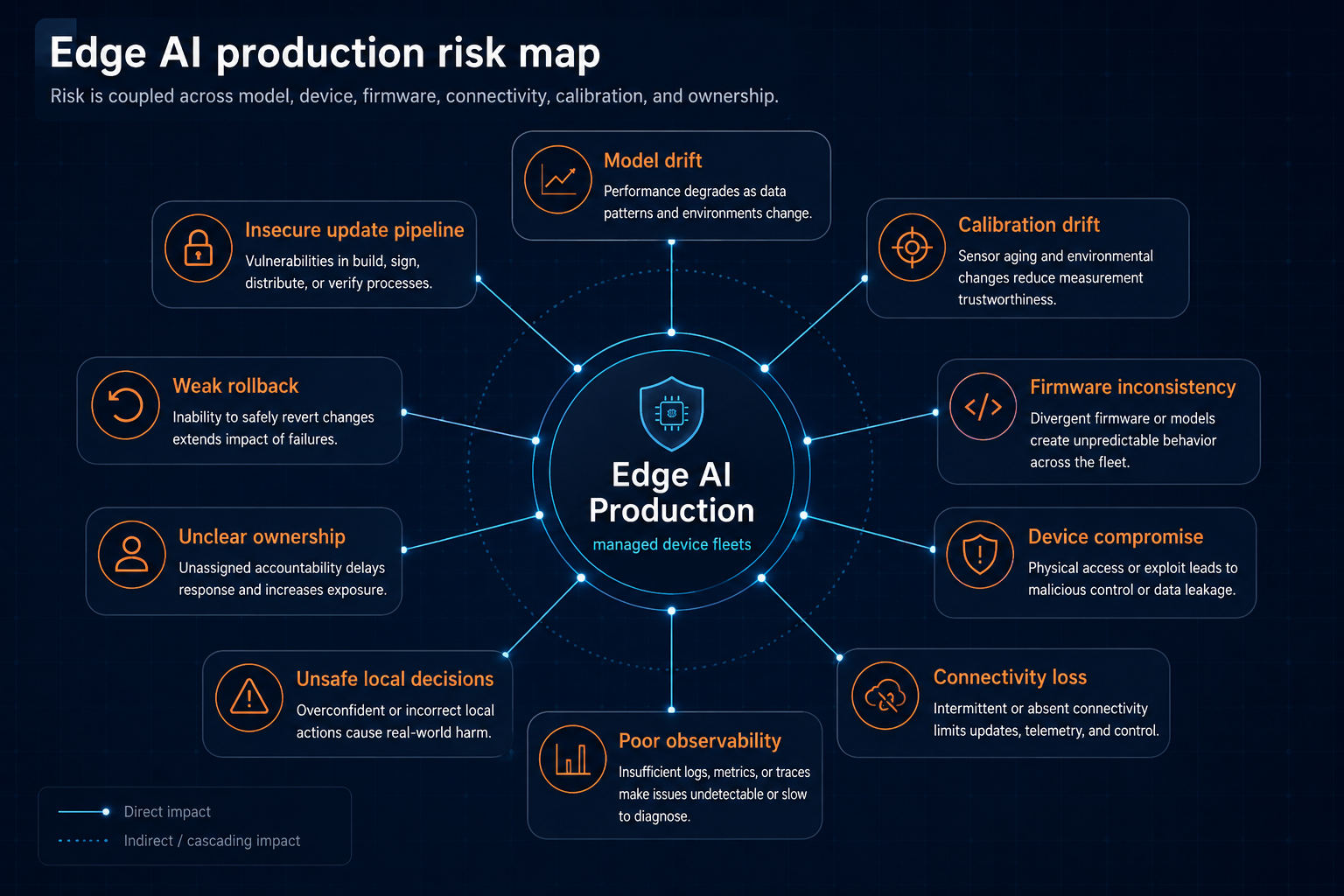
Prototype accuracy is not the same as field reliability. A TinyML model that works in a lab, on a notebook, or in a controlled demonstration still has to withstand firmware changes, sensor drift, calibration differences, power constraints, connectivity gaps, security threats, and fleet heterogeneity.
Production readiness begins with effective lifecycle management. Every deployed model needs to be connected to specific details such as device type, firmware version, configuration status, calibration state, training data context, and release decision. If a device exhibits an unusual inference pattern, the team must be able to determine the responsible model, the firmware used, the sensor configuration at the time, and whether the device was functioning under expected conditions. Without this comprehensive chain of evidence, troubleshooting turns into guesswork.
Hardware heterogeneity complicates this task. A fleet might consist of STM32-based sensor nodes, ESP32-connected devices, custom environmental boards, Raspberry Pi gateways, and cloud services. Each type may have different memory capacities, communication protocols, firmware update methods, security features, telemetry formats, and operational tolerances. If these variations are not explicitly modeled, teams risk inconsistent performance in the field, even if the overall architecture appears correct.
The calibration lifecycle requires clear recognition. Sensors degrade over time, and calibration assumptions may shift. Enclosures influence thermal performance. Factors such as dust, moisture, vibration, and installation environments can alter signal quality. A model relying on sensor data is only as trustworthy as the measurement process supporting it. Therefore, the calibration status should be incorporated into the device and model metadata rather than treated as a standalone maintenance note.
Model drift poses a significant challenge. Physical environments evolve, usage patterns change, buildings are reconfigured, machines experience wear, and urban conditions fluctuate seasonally. When the input data distribution shifts, a local model can gradually perform poorly without obvious signs. Since edge devices often do not stream all raw data permanently, drift detection needs to be deliberately integrated. This can involve confidence telemetry, anomaly counters, sampled raw data windows, calibration assessments, and regular validation against cloud-based analysis.
Updates are just as crucial. Edge AI links firmware, model binaries, runtimes, and configurations, so a model update might need operator support unavailable in the current runtime. Firmware changes can alter memory behavior, while calibration updates may shift the expected input distribution for the model. OTA (Over-the-Air) updates require signing, staged rollout, rollback capabilities, compatibility checks, and device health monitoring. Research into on-device online learning and semantic management highlights the larger challenge of overseeing TinyML systems beyond simple prototypes, particularly when models need to adapt or be maintained over time [13].
Observability is harder at the edge because monitoring cannot assume constant connectivity or unlimited telemetry volume. Teams need to determine which signals are essential: inference latency, memory usage, battery level, sensor health, calibration status, confidence scores, anomaly counts, model version, firmware version, update status, and gateway synchronization state. Too little telemetry makes the system opaque, while too much telemetry undermines the purpose of edge processing in the first place.
Physical security redefines the trust boundary by addressing the vulnerabilities of edge devices, which can be located in factories, streets, buildings, vehicles, or homes. Unlike cloud systems protected by centralized identity, network controls, logging, and managed security services, edge devices may be lost, tampered with, replaced, disconnected, or exposed to unexpected conditions. Security measures must include secure boot, signed firmware and model updates, key management, communication encryption, device identity, and decommissioning. Literature on IoT and AI security emphasizes that distributed intelligent systems require ongoing attention to updates, patching, and cyber risk management [23].
Production readiness encompasses device retirement, which involves revoking credentials, removing devices from fleet inventory, and preserving necessary audit records. Hardware that is abandoned should not continue to be trusted just because it was previously provisioned properly. This is a lifecycle issue, not merely an administrative task.
Production readiness is not just a checklist item. It is the operating model for releasing, observing, updating, rolling back, investigating, and retiring edge intelligence. For infrastructure teams, this is where Edge AI stops being an experiment and becomes part of the organization's reliability surface.
Edge AI Production Readiness Checklist
| Area | Question to validate | Why it matters | Risk if ignored |
|---|---|---|---|
| Model lifecycle | Can every deployed model be traced to training context, release approval, device type, and runtime? | Debugging and accountability depend on knowing what model made a decision. | Untraceable behavior and slow incident response. |
| Firmware and model versioning | Are firmware, model, configuration, and calibration versions linked? | A model may depend on runtime and input assumptions. | Silent incompatibility and inconsistent fleet behavior. |
| Calibration lifecycle | Is calibration state tracked and connected to device and model metadata? | Sensor quality shapes model quality in the field. | Reliable-looking predictions built on degraded measurements. |
| Observability | Which telemetry is required for inference health, device health, and fleet status? | Edge systems cannot be trusted if they cannot be observed. | Opaque local decisions and missed degradation. |
| Drift detection | How will shifts in data, sensors, or environment be detected? | Physical systems change over time. | Degraded model performance without visible failure. |
| OTA update strategy | Are updates signed, staged, monitored, and compatible with device constraints? | Updates are part of the reliability surface. | Bricked devices, inconsistent rollout, or security exposure. |
| Security | Are device identity, secure boot, encryption, and update verification in place? | Edge devices can be physically exposed and distributed. | Device compromise or unauthorized model execution. |
| Data governance | Is the system minimizing data movement while preserving audit evidence? | Privacy and usefulness must be balanced. | Overcollection, under-auditability, or compliance exposure. |
| Fleet management | Can devices be provisioned, monitored, reconfigured, and retired safely? | Edge AI scales through fleets, not isolated prototypes. | Configuration drift and unmanaged assets. |
| Incident response | Can teams diagnose local decisions under partial connectivity? | Incidents may appear first as edge anomalies. | Slow triage and unclear escalation paths. |
| Rollback strategy | Can models and firmware return to a known stable state? | Not every release behaves correctly in the field. | Extended outages or unsafe local behavior. |
| Device retirement / decommissioning | Are credentials revoked and devices removed from inventory when retired? | Abandoned devices should not remain trusted. | Residual access paths and stale fleet records. |
| Ownership and accountability | Who owns model performance, device health, security, and decision boundaries? | Distributed intelligence needs clear responsibility. | Policy gaps and unresolved operational responsibility. |
| Autonomy boundaries | Which local actions require gateway, cloud, or human confirmation? | Local inference needs bounded authority. | Unsafe or unauditable local behavior. |
Section 08
Governance, observability, and security at the edge
When decisions are made outside the cloud, governance also becomes more decentralized. Relying solely on a central policy document is insufficient. Instead, the system must implement governance through device configurations, model approval procedures, telemetry agreements, update management, and operational responsibilities.
Local decisions require local auditability. A device that classifies an event, suppresses a signal, triggers an alert, or changes local behavior should leave sufficient trace to explain what happened. That does not mean storing every raw input indefinitely. It means keeping the minimum evidence needed for debugging, safety review, incident analysis, and model improvement. This can include event metadata, model version, confidence score, timestamp, sensor health, calibration state, and, when appropriate, a limited sample of surrounding data.
Governance should establish clear boundaries for autonomy: determining which actions a device can perform locally, which require gateway approval, which need cloud validation, and which conditions call for human review. Without such boundaries, local inference risks becoming a black box with ambiguous authority.
Observability must be designed to function with intermittent connectivity. Devices might need to buffer telemetry, summarize events, or report health status opportunistically. The cloud-level observability layer should accommodate partial data, stale device states, delayed events, and inconsistent fleet conditions. Relying on a monitoring system that assumes constant connectivity can lead to misinterpretation of edge conditions or failure to detect failure modes.
Security must cover the entire process from model development to device deployment. A compromised update pipeline can turn a single model release into a risk affecting the entire fleet. A weak device identity model can allow unauthorized hardware to connect to the system. Inadequate key management can lead to data exposure or compromise management channels. Physical exposure requires teams to assume some devices might be accessible to attackers. Governance and security measures for AI, along with IoT governance strategies, are important because Edge AI combines model behavior, device behavior, and operational risks.
Accountability must be established prior to scaling. Who is responsible for the model's performance after deployment? Who approves updates? Who investigates incidents? Who determines when to disable an edge model? Who is responsible for distinguishing between device failure, model failure, calibration issues, and connectivity problems? These questions are architectural, as they influence the structure of the system, not just the policies governing it.
Section 09
Edge intelligence needs architectural clarity
TinyML and Edge AI do not eliminate the necessity of cloud architecture; instead, they increase its importance. As intelligence becomes spread across devices, gateways, and cloud systems, teams must have a clear understanding of data flows, decision boundaries, model ownership, security measures, hardware limitations, and operational feedback loops.
The key question isn't whether every system should run AI at the edge. Many systems shouldn't. When latency isn't critical, connectivity is consistent, privacy concerns are moderate, and the model demands heavy computation or updates often, cloud inference might be preferable. Conversely, if immediate local responses, bandwidth savings, privacy, or offline functioning are important, edge inference can be justified. When both conditions apply, a hybrid inference approach is usually the most responsible option.
The maturity of an Edge AI project is reflected in how clearly its responsibilities are defined. The device must not become an opaque black box. The gateway should never function as an unmanaged link. The cloud must not serve as a catch-all for cluttered telemetry data. Governance needs to be integrated from the start, not added later. From the outset, architecture should incorporate model lifecycle management, calibration, observability, security, autonomy boundaries, and accountability.
This is fundamentally an issue of architectural clarity. Edge AI proves most useful when teams understand where decisions are made, the flow of signals, model governance, the capabilities of each device class, and the system's response to changes in connectivity, data quality, calibration, or device status.
Mature, intelligent infrastructure is unlikely to be solely cloud-based or entirely edge-based. Instead, it will be structured around an appropriate distribution of responsibilities. At Infram8, we believe that infrastructure teams require this level of clarity before they can effectively scale distributed intelligence.
Section 10
Key takeaways
- TinyML changes where inference can happen, not only how small a model can become.
- Hardware selection is architecture selection: device class affects memory, latency, energy, update strategy, observability, security, and governance.
- Cloud, edge, and device layers are complementary. The architecture question is responsibility distribution.
- Sensor data can benefit from temporal modeling, but the best model depends on signal characteristics, device constraints, and maintainability.
- 1D-CNNs can be practical for many edge time-series tasks, but LSTMs and simpler classical models still have valid roles.
- Production readiness depends on lifecycle management, observability, rollback, device security, calibration, and governance, not only accuracy.
- Edge AI initiatives should define autonomy boundaries, accountability, and decision ownership before scaling distributed deployments.
References
References
- [1] Lin, J., Zhu, L., Chen, W. M., Wang, W. C., and Han, S. (2024). Tiny Machine Learning: Progress and Futures. arXiv:2403.19076.
- [2] Papadopoulos, S. et al. (2022). TinyML for Ultra-Low Power AI and Large Scale IoT Deployments: A Systematic Review. Future Internet.
- [3] Yahyati, C. et al. (2025). Systematic review of state-of-the-art TinyML and time-series classification approaches.
- [4] Saha, B., and Samanta, R. (2026). Rethinking Temporal Models for TinyML: LSTM versus 1D-CNN in Resource-Constrained Devices. arXiv:2603.04860.
- [5] From Tiny Machine Learning to Tiny Deep Learning: A Survey. (2025). arXiv:2506.18927.
- [6] A Review on the Emerging Technology of TinyML. (2024). ACM. DOI: 10.1145/3661820.
- [7] Edge-AI: A Systematic Review on Architectures, Applications, and Related Topics. (2025).
- [8] Optimizing Edge AI: A Comprehensive Survey on Data, Model, and System Optimization. (2025). arXiv:2501.03265.
- [9] Application of Tiny Machine Learning in Predictive Maintenance in Industrial Settings: A Systematic Literature Review. (2024).
- [10] Ahmed, A. et al. (2024). TinyML Network Applications for Smart Cities. In TinyML for Edge Intelligence in IoT and LPWAN Networks. Elsevier.
- [11] Muthusamy, S. et al. (2025). TinyML with CTGAN-based Smart Industry Power Load Classification. Scientific Reports.
- [12] Edge Computing in Healthcare Using Machine Learning. (2024). WIREs Data Mining and Knowledge Discovery.
- [13] On-device Online Learning and Semantic Management of TinyML Systems. (2024). ACM. DOI: 10.1145/3665278.
- [14] Edge Enhanced Network Monitoring Using TinyML. (2024). MSc thesis, University of Oulu.
- [15] TinyML for Edge Intelligence in IoT and LPWAN Networks. (2024). Elsevier.
- [16] TensorFlow Lite for Microcontrollers official documentation. Google.
- [17] LiteRT for Microcontrollers official documentation. Google AI Edge.
- [18] Lai, L., Suda, N., Chandra, V., and Cao, H. (2018). CMSIS-NN: Efficient Neural Network Kernels for Arm Cortex-M CPUs. arXiv:1801.06601.
- [19] Edge Impulse deployment documentation.
- [20] CEVA. (2025). The 2025 Edge AI Technology Report.
- [21] Metadesk Global. (2024). IoT and AIoT Governance: Why It Matters More Than Ever.
- [22] AI Governance, AI Safety, and AI Security Controls. (2023). IJCATR.
- [23] Security Risks: Concerns of Generative AI in the IoT. (2024). arXiv:2404.00139.